 how-to
How Do You Choose the Right Art for a Living Room?
Last Updated: October 25, 2026
Quick Summary
Choose living room art by measuring first: size the piece to 60 to 75 percent of the sofa's width and hang its center at 145 cm (57 in) from the floor. Match colors and frames to the room, and preview the piece on your wall before buying.
- Measure wall width, wall height, and the width of the largest furniture piece before shopping.
- Art above a sofa should span 60 to 75 percent of the sofa's width.
- Keep the bottom edge 15-25 cm (6-10 in) above the sofa back.
- Hang art to the side of a television, never above the screen.
- Test colors with a small proof in morning and evening light before committing.
Table of Contents
- Start With the Wall, Not the Art
- Living Room Art Size Guide: Matching Scale to Your Space
- How to Hang Art Above a Sofa Without Getting It Wrong
- Choosing Colors and Style That Fit the Room
- Living Room Wall Art Ideas for Every Layout
- Why Large Wall Art for Living Rooms Changes the Whole Room
- Lighting, Glare, and Protecting Your Investment
- Preview Your Piece Before You Commit
- Frequently Asked Questions
Start With the Wall, Not the Art
Most people shop for living room art backwards: they fall for a piece online, then try to make it fit a wall it was never meant for.
At DE LA Gallery, we have watched this play out with collectors and first-time buyers alike.
Below are the exact measuring steps, sizing rules, and placement mistakes that make even museum-quality pieces look wrong.
Measure Available Wall Space and Furniture Widths
Grab a tape measure and a notepad. You need three numbers: wall width, wall height, and the width of the largest piece of furniture on that wall.
- Wall width: measure edge to edge, then subtract obstructions like windows, doors, or a fireplace.
- Sofa width: measure the outer frame, not the cushions.
- Ceiling height: note it, because tall walls change how high art should sit.
Identify the Room's Focal Point
Every living room has one natural anchor: a fireplace, a television, or the main sofa wall. Decide which before you buy anything.
Art should support that anchor, not compete with it. A bold piece beside a fireplace fights for attention; above a quiet sofa wall, it becomes the star.
Living Room Art Size Guide: Matching Scale to Your Space
The right artwork size depends on two things: the width of the furniture below it and the wall space around it. Too small looks like a postage stamp; too large swallows the room.
Use this quick reference before you shop:
| Wall or Furniture Width | Suggested Art Width | Best Format |
|---|---|---|
| Sofa under 1.8 m (6 ft) | 90-110 cm (36-43 in) | Single medium piece |
| Sofa 1.8-2.4 m (6-8 ft) | 120-150 cm (48-60 in) | Single large piece or pair |
| Sofa over 2.4 m (8 ft) | 150-210 cm (60-84 in) | Large statement piece or triptych |
| Full empty wall | 60-75% of wall width | Gallery wall or oversized single |
The 60 to 75 Percent Rule for Sofa Walls
Art hung above a sofa should span 60 to 75 percent of the sofa's width, the most useful rule in living room art sizing.
A 2.4 m (8 ft) sofa calls for art roughly 1.4 to 1.8 m (56-71 in) wide. Smaller looks lost; wider overpowers the seating area.
For a pair or set of 2-3 paintings, add the frames together and treat the total width as one unit. Leave 5-8 cm (2-3 in) between frames so the grouping reads as a single composition.
How to Hang Art Above a Sofa Without Getting It Wrong
Hang art so its center sits at 145 cm (57 in) from the floor, standard gallery height and average eye level. Above a sofa, keep the bottom edge 15-25 cm (6-10 in) above the sofa back.
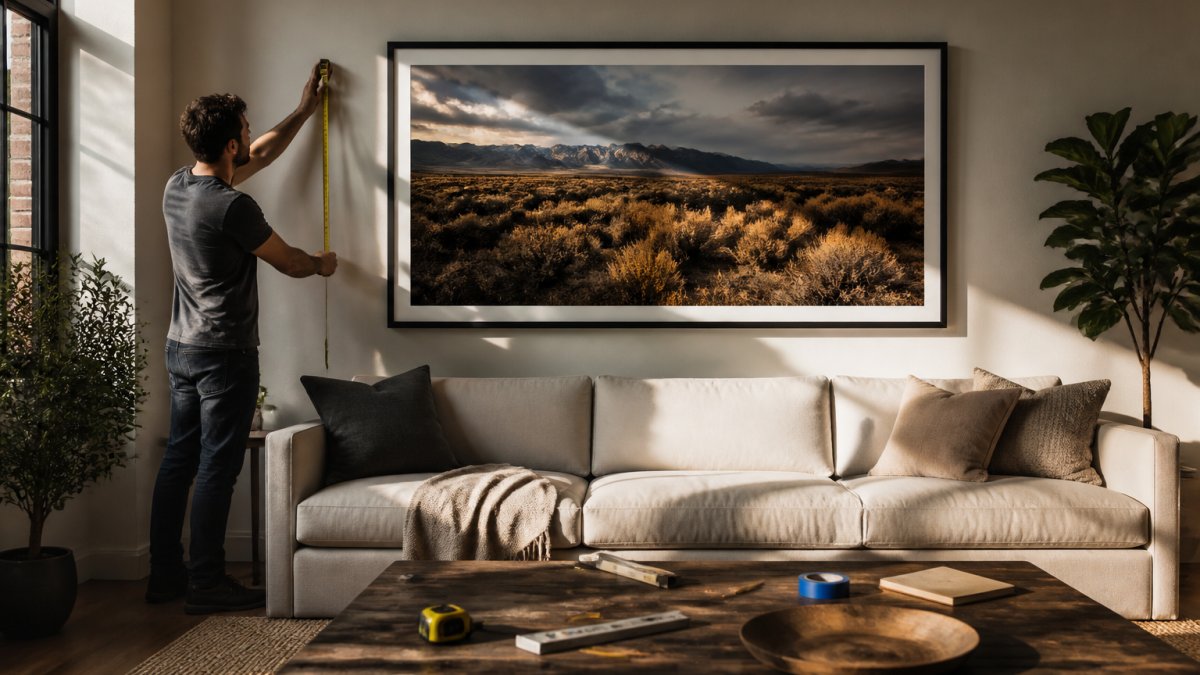
Here is the sequence we recommend:
- Measure 145 cm (57 in) up from the floor and mark the wall lightly with pencil.
- Measure the art's height, divide by two, and mark that distance down from the center point. That is your hanging hook line.
- Hold the piece in place with painter's tape before drilling.
- Step back at least 3 m (10 ft) and check the visual balance.
- Drill and hang only when the taped position looks right.
Watch out: hanging art too high is the most common mistake. People instinctively hang above eye level, leaving a disconnected gap between art and sofa.
Choosing Colors and Style That Fit the Room
Art should either echo the room's palette or deliberately break it. Both work, but know which effect you want and test it first.
The Three Color Strategies
- Coordinate: pull one or two colors from your rug, curtains, or throw pillows into the artwork. Safest and easiest to get right.
- Contrast: place a bold, vibrant piece in a neutral room to create a focal point. Contrast works best when the rest of the room is quiet; a loud piece in a loud room reads as chaos.
- Soothing: choose soft, muted tones in a busy room to calm the space. Muted art in a muted room can disappear, so add one darker frame or mat.
Test the Palette Before You Commit
Color on a screen is not color on your wall. Before buying, test physically:
- Sample the room's colors. Pull paint chips or fabric swatches from the rug, curtains, and pillows, and lay them side by side.
- Print a small proof. Most print sellers offer a small proof or a low-cost sample print. Tape it to the wall at the intended height and live with it for a few days.
- Check it in morning and evening light. A piece that looks warm at noon can look muddy at night. If the color shifts badly, it is wrong for that wall.
- Use an AR preview if available. Augmented reality tools project the piece onto your actual wall at actual scale, which catches both color and size problems before you pay.
Match the Frame to the Room's Dominant Material
Frame choice is a color decision too. Warm wood frames suit traditional rooms and wood floors; thin black or white frames suit contemporary spaces.
A useful rule: match the frame to the room's second-most-common material, not the first. If the room is mostly white walls with a wood floor, a wood frame ties the art to the floor without competing with the walls.
Account for How Light Changes Color
Light is the silent variable in every color decision. Direct sunlight warms colors and fades pigments; north-facing light cools them and can make warm tones look flat. Check the wall at the time of day you use the room most. If it gets direct sun, favor UV-filtering glass and pigment-based inks.
For a full breakdown of preservation methods, read our collector's guide to protecting fine art.
Living Room Wall Art Ideas for Every Layout
Layout dictates format, but most guides stop at "wide wall, wide art." The harder question is what to do when the wall is not a clean rectangle. Here are worked solutions for the layouts that cause trouble.
The Standard Sofa Wall
A single oversized landscape print centered above the sofa is the default for good reason. Center the art on the sofa, not the wall, if the two are offset. Keep the bottom edge 6-10 in (15-25 cm) above the sofa back and size the piece to 60-75 percent of the sofa width. For a pair or triptych, treat the total framed width as one unit.
Narrow Walls and Walls Interrupted by Doors or Windows
A wall only 30-40 in wide cannot carry a wide landscape. Go vertical: a single portrait piece or stacked pair, centered on the wall segment rather than the room.
For a wall between two windows, a vertical piece that mirrors the window height creates a rhythm. Measure the window height, then choose art within 6-12 in of that height so the three elements read as a set.
Open-Plan Rooms and Asymmetrical Furniture
In an open-plan room, the sofa often floats rather than sitting against a wall. Anchor the art to the furniture, not the room: center the piece on the sofa at the standard 57-in center height. Even if the sofa is offset from the wall, this reads as intentional.
For an asymmetrical arrangement (a sofa plus a chaise, or a sofa plus two mismatched chairs), create a visual center by centering the art over the midpoint of the seating group, not over the sofa alone. A gallery wall can also absorb asymmetry: build it around a central anchor piece and let the outer frames balance the irregular furniture below.
Fireplace, Television, and Window Walls
- Fireplace wall: a single square or landscape piece above the mantel, no wider than the mantel itself. Keep the bottom edge at least 12 in above the mantel so heat does not damage the frame.
- Television wall: art to the side, never above the screen. Above-TV art competes with the screen and sits too high for comfortable viewing.
- Large window wall: vertical art between windows to frame the view, sized within 6-12 in of the window height.
Gallery Walls With a Repeatable Grid
A gallery wall is the most flexible solution for odd-shaped walls, but it needs a grid. For a 5-9 piece arrangement, pick a central anchor piece and space every frame 2-3 in apart, keeping the outer edges aligned to a rectangle.
If you want concrete large-format landscape print ideas to visualize in these layouts, browse our best large format landscape photography prints for scale and composition inspiration.
Why Large Wall Art for Living Rooms Changes the Whole Room
Scale separates decor from a statement.
A single oversized piece often works better than several small ones. One large framed print reads as intentional.
This is where format matters. Large-format fine art photography, printed and framed at scale, holds detail that small reproductions lose.
If you want to go deeper on committing to a statement piece, our guide on how to choose large wall art walks through the decision in full.
Lighting, Glare, and Protecting Your Investment
Light is the silent killer of fine art. Direct sunlight fades pigments over time, and glare washes out detail even on a bright afternoon.
Protect your piece with these steps:
- Hang art away from direct sun, or use UV-filtering glass.
- Add a dimmable picture light above the frame for evening viewing.
- Keep art off walls near heat sources like radiators or fireplaces.
Verified archival materials matter here. Pigment-based inks and acid-free matting resist fading far better than standard prints. Ask any seller what materials they use before you buy.
For a full breakdown of preservation methods, read our collector's guide to protecting fine art.
Preview Your Piece Before You Commit
Buying art online used to mean guessing. Today, augmented reality previews let you see a piece on your actual wall, at actual scale, before you pay.
At DE LA Gallery, our AR preview tool projects each photograph onto your wall through your phone.
Before you commit, confirm three things:
- The print uses archival, pigment-based materials.
- The size matches your measured wall and furniture width.
- The seller offers a clear return or replacement policy.
If you are ready to buy, our complete guide to buying large scale photography online covers the process step by step, and our guide on identifying archival quality prints shows you exactly what to check.
Choosing art for a living room gets easier once you stop guessing and start measuring.
Get started with DE LA Gallery and find a large-format piece built for your living room.
Frequently Asked Questions
How high should art be hung above a sofa?
The bottom edge of the frame should sit 6 to 10 inches above the back of the sofa, which keeps the piece visually connected to the furniture rather than floating. Center the artwork at roughly 57 inches from the floor, the standard eye-level guideline. For a very tall sofa or a low ceiling, stay closer to the 6-inch gap. Always tape the frame outline on the wall first and step back to check the proportion before you drill.
How do I choose the right size art for a living room?
Use the 60 to 75 percent rule: the artwork, or the full grouping, should span about 60 to 75 percent of the sofa or console beneath it. A 90-inch sofa calls for a piece or arrangement roughly 54 to 68 inches wide. On an empty wall, aim for art that covers about two-thirds of the available width. Undersized art on a large wall is the most common mistake, so measure the wall before you shop.
Should living room art match the furniture and decor?
Coordinate rather than match. Pull one or two colors from your rug, upholstery, or throw pillows and let the art repeat them, but avoid buying a piece simply because it mirrors the sofa fabric. A landscape photograph with warm earth tones can tie a neutral room together without looking like a showroom set. Style should feel intentional, not identical, and personal taste should have the final say.
How do I arrange large art on a living room wall?
Treat a single large piece as the anchor and center it on the furniture below. For a pair or set of three, keep spacing between frames at 2 to 3 inches so the group reads as one unit. Lay the arrangement on the floor first, photograph it, then transfer the outline to the wall with painter's tape. Keep the center of the whole grouping at eye level and leave at least 8 to 10 inches of breathing room above furniture.