 ultimate-guide
How to Choose Large Wall Art: A 2026 Guide
Table of Contents
- Start With the Wall, Not the Art
- Large Wall Art Size Guide: Formulas That Work
- Triptych vs Single Large Art: Which Fits Your Space?
- How to Hang Large Wall Art Without Damaging Walls
- Lighting Large Art: Avoid Glare and Fading
- Archival Materials and Print-on-Demand Quality
- Frequently Asked Questions
Last Updated: September 29, 2026
Start With the Wall, Not the Art
Most people choose large wall art backwards: they order a piece they love, then discover it swallows the room or disappears into it. The wall should dictate the art.
Measure Width, Height, and Viewing Distance
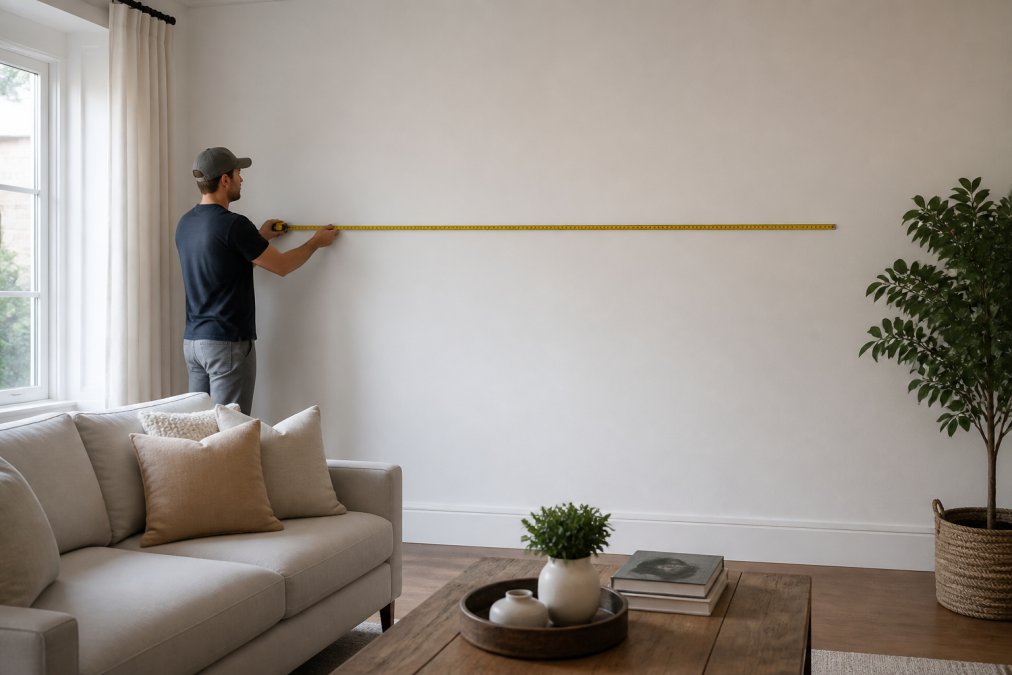
Measure the full wall width, then subtract permanent obstructions like door frames, sconces, or built-ins. Measure floor-to-ceiling height, note where furniture sits, and pace off your typical viewing distance.
Note Architectural Details and Light
Windows, crown molding, and sloped ceilings all change what a wall can hold. A large window on one side makes a centered piece look off-balance unless you account for the light source's visual weight. North-facing walls give cool, even light; south-facing walls flood the space with sun that can fade unprotected prints.
Large Wall Art Size Guide: Formulas That Work
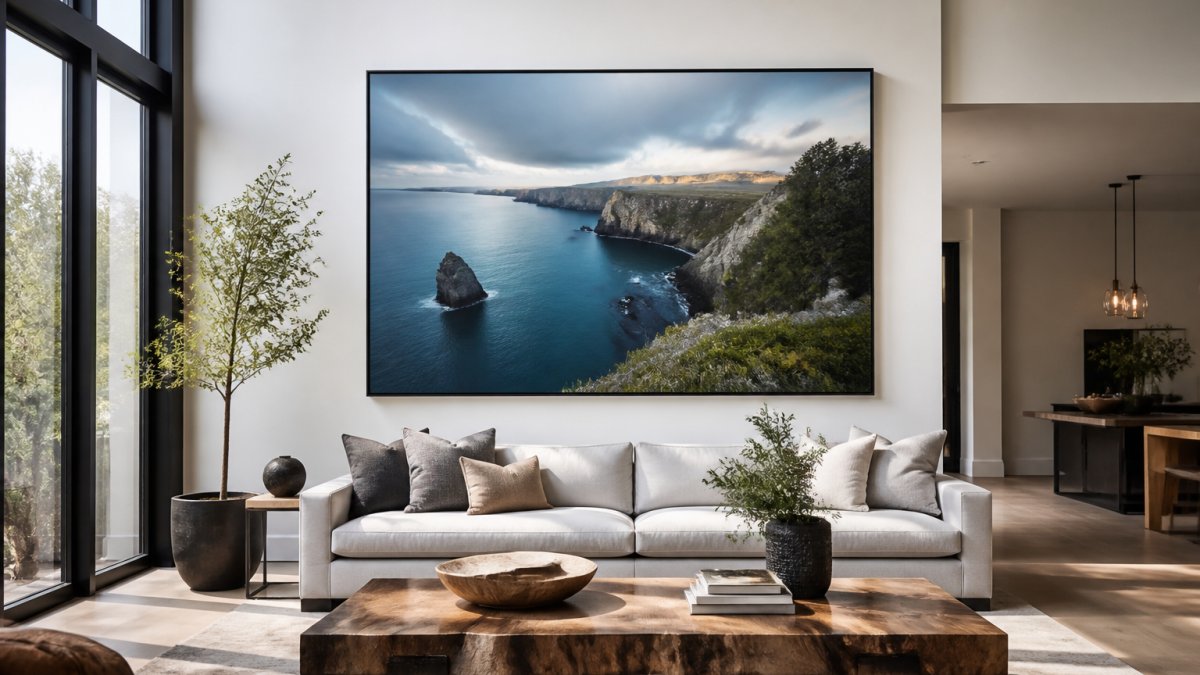
The simplest large wall art size guide: art should cover roughly 60 to 75 percent of the wall width above a piece of furniture, and its center should hang at eye level. These two rules solve most sizing problems.
The 57-Inch Rule and Eye Level
The 57-inch rule places the artwork's center 57 inches from the floor, average human eye level. For a large piece, the bottom edge often lands 30 to 40 inches up the wall, above most furniture backs.
Wall Coverage Ratios for Sofas and Beds
For a sofa, aim for art spanning 60 to 75 percent of its width, a 72-inch sofa pairs with a piece 43 to 54 inches wide. For a bed, span roughly two-thirds of the headboard width, high enough that a seated person doesn't hit it.
| Furniture | Furniture Width | Target Art Width (60-75%) |
|---|---|---|
| Loveseat | 60 in | 36-45 in |
| Standard sofa | 84 in | 50-63 in |
| Sectional | 120 in | 72-90 in |
| Queen bed | 60 in | 40-45 in |
| King bed | 76 in | 50-57 in |
Triptych vs Single Large Art: Which Fits Your Space?
A single large piece delivers one uninterrupted focal point; a triptych splits the same visual real estate into three panels that flex around furniture and architectural details. The right choice depends on your wall's shape and how much visual weight you want.
How to Hang Large Wall Art Without Damaging Walls
Hanging large wall art well is a structural question as much as a design one. A framed 48-by-72-inch piece with glass, matting, and a hardwood frame can weigh 40 to 70 pounds, past 80 with museum glass or a metal frame. Drywall alone won't hold that safely; the failure mode is a corner ripping through the sheetrock.
Know What Your Wall Can Actually Hold
Before buying hardware, identify what's behind the paint. Three wall types behave very differently:
- Wood stud framing (typical in single-family homes): studs are usually spaced 16 inches on center, sometimes 24. A #10 or #12 wood screw driven 1.5 inches into a stud can safely carry 50 to 100 pounds per point, depending on stud condition. This is the strongest option and always the first choice.
- Steel stud framing (common in newer commercial and multifamily construction): steel studs are thin gauge and will crush under a screw. You need self-drilling screws paired with a toggle-style anchor, or a snap-toggle rated for the load.
- Masonry or brick: requires a carbide-tipped masonry bit and a sleeve anchor or expanding bolt. Never use a plastic expansion anchor in brick or block, it will pull out.
Hardware Rated for the Weight
Standard picture hooks are rated for light pieces only, typically 10 to 20 pounds. Anything heavier needs matched hardware:
| Hardware | Typical Working Load | Best For |
|---|---|---|
| Standard picture hook | 10-20 lb | Small, lightweight pieces |
| Self-drilling toggle anchor (e.g., SnapSkru, Toggler) | 40-80 lb per anchor in 1/2 in drywall | Medium to heavy pieces, no studs |
| Heavy-duty toggle bolt | 50-100+ lb per anchor | Very heavy pieces, no studs |
| French cleat (aluminum, 12-24 in) | 100-300+ lb depending on length and fasteners | Large, heavy pieces; distributes load across width |
| Z-bar / interlocking bracket | 100-200+ lb | Wide pieces, easy leveling |
Two-Person Installation Steps
- Mark the wall's center point and confirm the 57-inch eye-level height.
- Tape the piece's dimensions on the wall before drilling to catch proportion problems.
- Locate studs and mark anchor points; if none, mark toggle anchor positions.
- Drill pilot holes, install wall-side hardware; for a French cleat, level it across two studs and screw into each.
- Attach the matching bracket or cleat rail to the frame's top rail, centered.
- One person holds the piece level and slightly off the wall while the second seats it and confirms it's fully engaged.
- Step back 10 feet and check level, centering, and gaps.
If you're hanging on a wall you can't drill, a rental, a plaster wall you don't want to repair, or a brick fireplace, a floor-standing easel or a leaning shelf is a legitimate alternative for pieces under 40 pounds. Just secure the top of the frame to the wall with a small strap or museum putty so it can't tip.
When to Call a Pro
If the piece is wider than your arm span, weighs more than 80 pounds, or goes on a wall with plumbing, electrical, or HVAC behind it, hire an installer. A licensed handyman or art installer typically charges $75 to $200 per piece, far less than repairing a wall or replacing a damaged print. Ask them to confirm stud locations and use hardware rated for double the piece's weight.
The single most common cause of large art falling is under-rated hardware, not bad luck. Match the anchor to the wall type, use a safety factor of two, and never hang alone.
Lighting Large Art: Avoid Glare and Fading
Lighting is where most large art setups fall apart. Direct, unfiltered light creates hot spots and glare, and fades even quality prints. The goal is even, indirect illumination that reveals the artwork without competing with it, and the fixture matters as much as placement.
Three Lighting Approaches and When to Use Each
Picture lights mount above the frame and wash the surface from close range. They suit single pieces and walls where you can't run track or recessed lighting, but they create a bright band at the top with falloff toward the bottom. Choose a rotatable shade so you can aim the beam down the face of the art.
Color Temperature, CRI, and Beam Angle
Not all LEDs render art the same way. Three specifications matter:
- Color temperature (CCT): 3000K to 3500K is the sweet spot for most art. Below 2700K the light turns warm and yellow, shifting blues and greens. Above 4000K it turns cool and clinical, washing out warm tones. If your room already has warm ambient lighting, match it at 3000K so the art doesn't read as a cold rectangle on a warm wall.
- Color rendering index (CRI): Look for CRI 90 or higher. CRI measures how accurately a light source renders colors compared to natural daylight. A CRI of 80 will make reds look muddy and skin tones in portraits look gray. CRI 95+ is ideal for photography and fine art.
- Beam angle: A narrow beam (15-25 degrees) creates a spotlight effect that works for small pieces but leaves the edges of a large piece dark. For art wider than 36 inches, use a 36- to 60-degree beam so the cone covers the full surface at your mounting distance.
Protecting Art From UV and Heat
If your wall gets direct sun, treat it like any light-sensitive surface. UV radiation is the primary cause of fading in prints and photographs, and it acts cumulatively, two hours of direct sun a day fades a piece noticeably within a few years.
- UV-filtering glazing: Museum glass blocks up to 99% of UV and reduces glare, but it costs significantly more than standard glass and adds weight. Acrylic glazing with a UV filter is lighter and shatter-resistant, which matters for large pieces.
- Archival inks and papers: Pigment-based inks resist fading far better than dye-based inks, but no ink is fully UV-proof. Rotating pieces away from the harshest exposure every few months extends their life.
- Heat: Incandescent and halogen bulbs emit significant heat that can dry out canvas and accelerate fading. LED fixtures run cool and are the only sensible choice for art lighting today.
A simple test: stand where you'll normally view the art and look at the surface. If you can see a bright reflection of a window, lamp, or your own face, you have glare. Reposition the light source, tilt the fixture, or switch to a matte or anti-reflective glazing.
Good art lighting is invisible. If you notice the fixture before you notice the artwork, the angle, beam, or color temperature is wrong. Aim for CRI 90+, 3000K-3500K, and a 30-degree grazing angle, and let the art be the brightest thing on the wall.
Archival Materials and Print-on-Demand Quality
The single most important test of quality is what's behind the glass. Ask any seller what ink, paper, and backing they use. If they can't answer clearly, the print won't last.
Direct-from-artist sourcing makes a real difference here. DE LA Gallery prints and frames in-house with verified archival materials, so you can trace every layer from ink to frame, transparency that matters to collectors burned by washed-out prints.
Frequently Asked Questions
What is the 57-inch rule for hanging art?
The 57-inch rule means the center of your large wall art should sit 57 inches from the floor. This matches the average human eye level and creates a balanced focal point in most rooms. If your ceiling is taller than 9 feet or your furniture is very low, adjust up or down by 2 to 4 inches. Always measure from the floor to the center of the piece, not the top.
How do I choose between a triptych and one large piece?
Choose a triptych when you want flexibility to rearrange or when your wall has architectural details like a window or column that a single piece would cover awkwardly. A single large piece works better for a bold statement and simpler hanging. For a triptych, keep total width within 60 to 75 percent of your sofa width. For a single piece, aim for 50 to 60 percent of the sofa width.
What archival materials should I look for in large-format photography?
Look for pigment-based inks rated for 100+ years and acid-free, cotton rag or baryta paper. Framing should use UV-filtering glass or acrylic and acid-free matting. Ask the seller for material certifications. DE LA Gallery uses verified archival materials and in-house printing by Jeffrey Rodriguez, so you can confirm longevity before buying. Avoid unknown inks or standard glass, which fade faster.
How much does large wall art cost?
Pricing depends on size, framing, edition size, and whether the piece is an original or open edition. Museum-quality large-format photography from an artist-direct gallery typically costs more than mass-produced prints because of archival inks, cotton rag paper, and custom framing. DE LA Gallery does not publish fixed prices online because each piece is made to order. Contact the gallery for a quote based on your dimensions and framing preferences.