 ultimate-guide
Best Ways to Protect Fine Art: A 2026 Collector's Guide
Last Updated: October 23, 2026
Quick Summary
To protect fine art, control light with UV-filtering glazing or window film, hang pieces away from direct sun, and use archival framing materials like acid-free mat board and inert backing. Handle prints with cotton gloves, store them flat in a cool, dry, dark place, and keep temperature at 65-70°F and humidity at 45-55%.
- UV-filtering glazing slows fading dramatically but does not stop it, so combine it with careful placement.
- Acid-free mat board prevents mat burn, and archival hinges should attach only at the top edge.
- Store prints flat with acid-free interleaving tissue and never roll them for long periods.
- Keep relative humidity steady and treat a swing of more than about 10% RH as the damage threshold.
- Standard homeowners policies usually cap fine art coverage, so ask about per-item limits and agreed-value settlement.
Table of Contents
- Why Fine Art Needs Protection: Light, Heat, and Handling
- How to Prevent Art From Fading: Light Control That Works
- Archival Framing for Art Prints: Materials That Last
- How to Handle Fine Art Prints Without Causing Damage
- Storing Fine Art Prints: Environment and Materials
- Environmental Targets: Temperature, Humidity, and Monitoring
- Beyond the Wall: Insurance, Documentation, and Emergency Planning
- Frequently Asked Questions
Why Fine Art Needs Protection: Light, Heat, and Handling
Fine art needs protection because three everyday forces attack it constantly: light, heat, and human hands. Light breaks down pigments and paper, heat and humidity warp and stain, and careless handling leaves creases and oils that never come out. At DE LA Gallery, we print and frame every piece with verified archival materials.
Damage is cumulative and invisible until it's obvious. A print that looks perfect for three years can show a faded rectangle where sunlight hit it, and by then the pigment is gone.
The best ways to protect fine art start before the piece reaches your wall: controlling the light it sees, the frame it lives in, the air around it, and how your hands touch it.
How to Prevent Art From Fading: Light Control That Works
To prevent art from fading, block ultraviolet light and limit visible light reaching the surface. UV radiation is the primary cause of pigment breakdown, though visible light and heat contribute over years. The fix combines UV-filtering glazing, window film, and smart placement.
Fading is the number one killer of fine art prints, and the one risk you can almost entirely eliminate. Two levers matter: the glazing and where the piece hangs.
UV-Filtering Glazing and Window Film
UV-filtering glazing is glass or acrylic that blocks most ultraviolet radiation before it reaches the artwork. Look for glazing rated to filter the large majority of UV light, and confirm the rating on the manufacturer's spec sheet.
Window film works on the other side of the equation. Applied to your windows, UV-filtering film cuts the ultraviolet load entering the room.
Neither option makes art light-proof. UV-filtering glazing slows fading dramatically but doesn't stop it, so combine it with placement choices.
Placement and Room Light Strategies
Hang art away from direct sunlight and bright light: no south- or west-facing walls that catch hours of afternoon sun, and no spot directly under a skylight.
Room light matters too. Halogen bulbs run hot and emit UV; switch to low-UV LED fixtures.
Rotate pieces if you can. A print that spends six months in a dim hallway and six in a brighter room ages far more slowly than one that never moves.
Archival Framing for Art Prints: Materials That Last
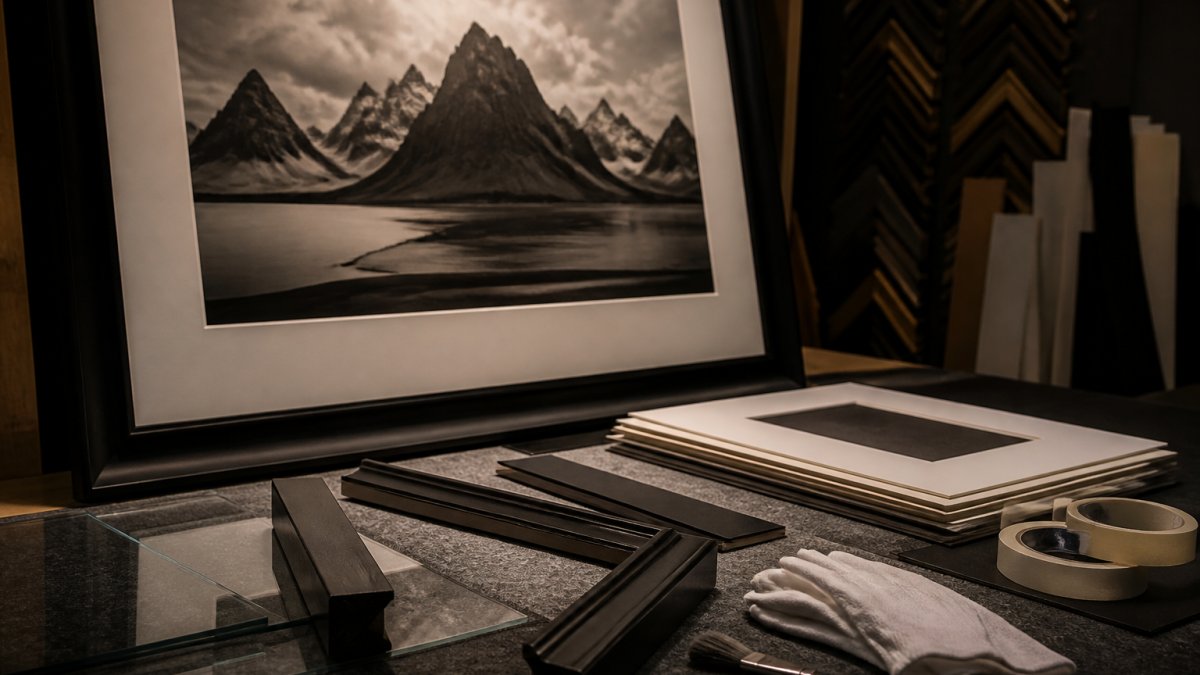
Archival framing for art prints means using materials that won't chemically interact with the artwork: acid-free mat board, inert backing, UV-filtering glazing, and hardware that doesn't rust or stain.
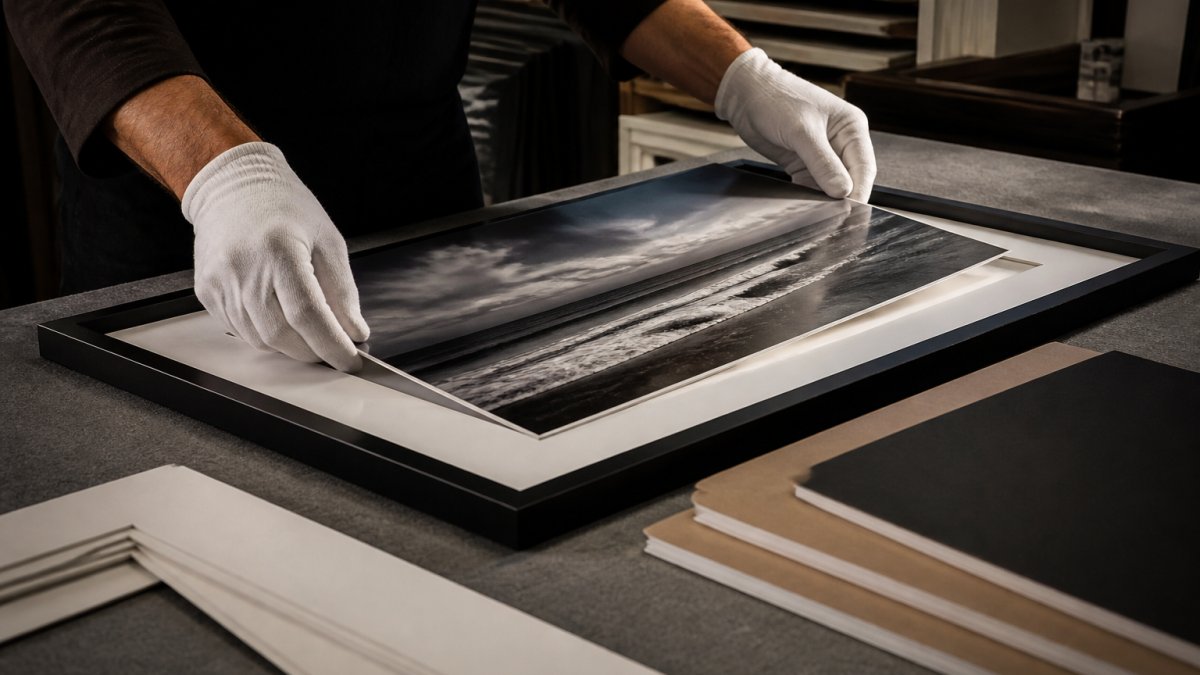
Standard mat board is acidic. Over time it off-gasses and burns a brown line into the paper, mat burn. Acid-free or buffered mat board prevents it.
Glazing should be UV-filtering. Acrylic is lighter and shatter-resistant, which matters for large-format pieces; glass is clearer but adds weight and risk.
Matting, Backing, and Hanging Hardware
Details that separate a lasting frame from a damaging one:
- Matting: Acid-free, with the mat not touching the art surface. A window mat creates an air gap that protects the print.
- Hinging: Attach the art to the backing with gummed linen tape or archival hinges at the top edge only, so the paper can expand and contract with humidity without tearing.
- Backing: Seal the back with an acid-free backing board and dust cover to keep insects and dust out.
How to Handle Fine Art Prints Without Causing Damage
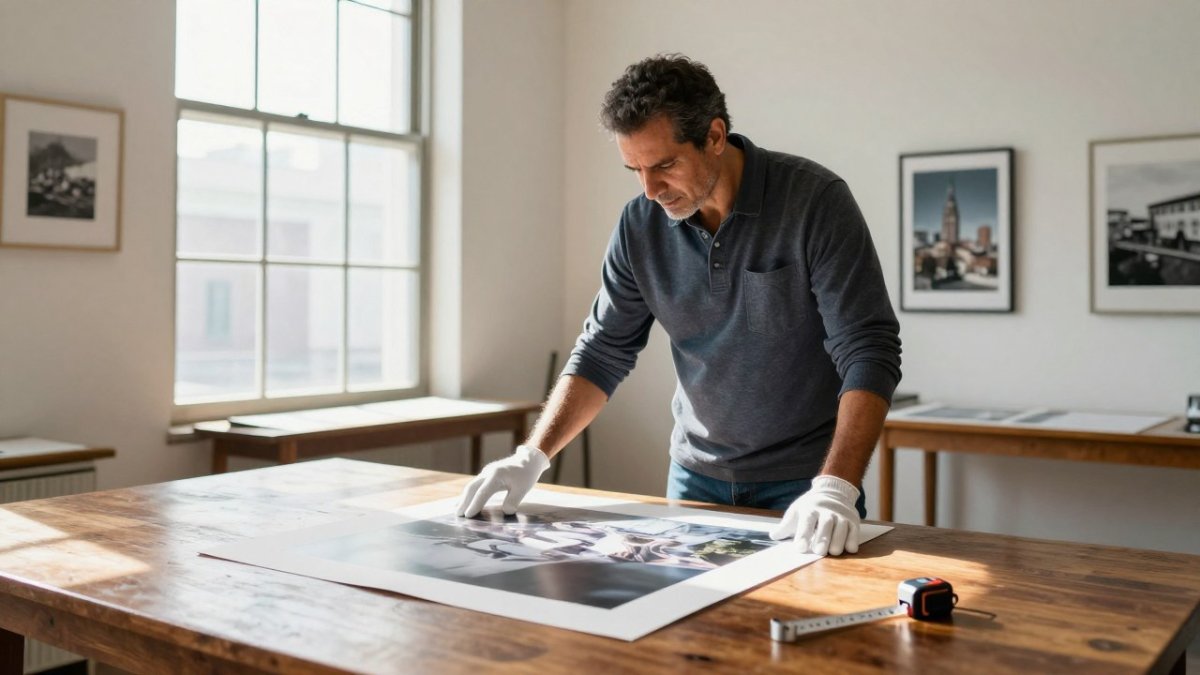
Handle fine art prints with clean, dry hands or cotton gloves, support the piece from underneath and at the edges, and never touch the printed surface. Skin oils are acidic and permanent, and a single crease can't be pressed out.
A few habits prevent most handling damage:
- Wear cotton gloves whenever you touch the print or its frame. Bare hands leave fingerprints that etch into emulsion over time.
- Hold from the edges and support the center. Never lift a large print by one corner; paper sags and creases under its own weight.
- Work on a clean, flat surface covered with a soft, lint-free cloth.
- Keep food and drink out of the room. A spill near an unframed print is a disaster with no undo.
- Let framed pieces acclimate before hanging if they've traveled through temperature swings.
When you move a framed piece, carry it by the sides of the frame, not the wire or the top rail. The wire is for hanging, not lifting.
Storing Fine Art Prints: Environment and Materials
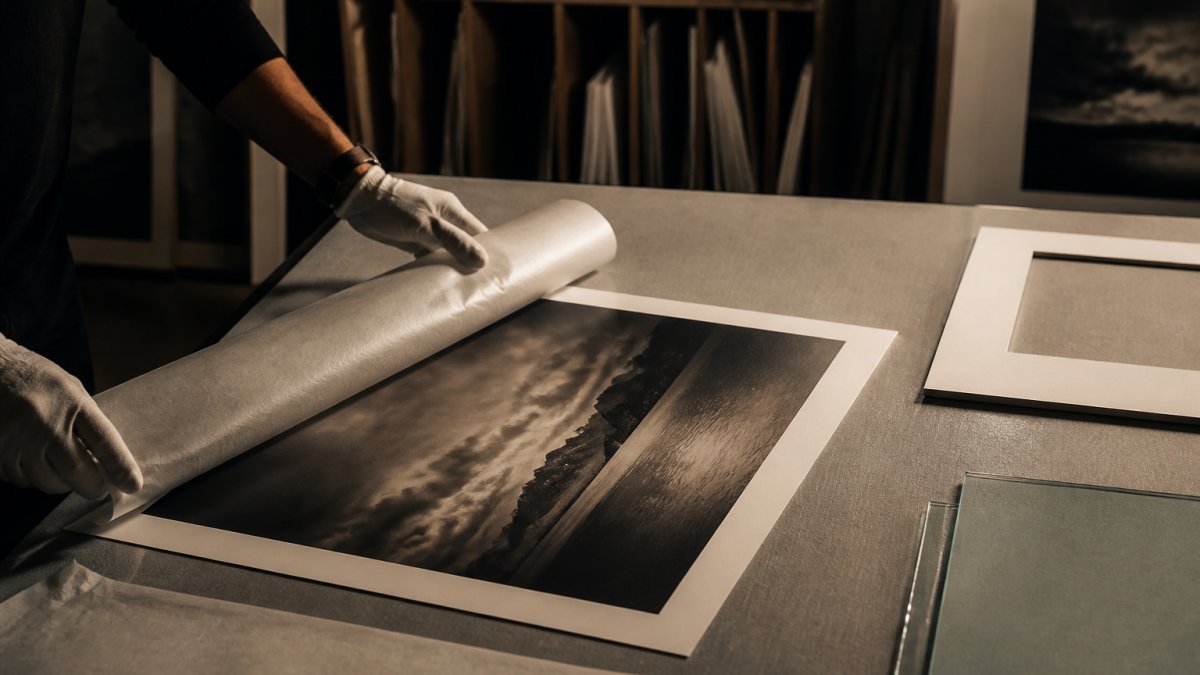
Store fine art prints flat, in a cool, dry, dark place, interleaved with acid-free tissue and enclosed in an archival sleeve or portfolio box. Avoid attics, basements, and garages, which swing between damp and dry and invite pests.
Materials for storage:
- Acetate sleeves or archival folders for individual prints, so surfaces never rub together.
- Acid-free interleaving tissue between stacked prints.
- A rigid portfolio box to keep pieces flat and shielded from light and dust.
Never store prints rolled for long periods unless the paper is designed for it; rolling stresses the surface and can leave a permanent curl.
Environmental Targets: Temperature, Humidity, and Monitoring
Aim for a stable indoor environment around typical museum conditions: roughly 65-70°F and 45-55% relative humidity, with fluctuations kept as small as possible. Stability matters more than any single number, because rapid swings do the most damage.
Practical targets for a home collection:
| Factor | Target | Why It Matters |
|---|---|---|
| Temperature | 65-70°F, steady | Heat accelerates chemical breakdown and embrittles paper |
| Relative humidity | 45-55%, steady | Below 40% paper cracks; above 60% mold and foxing risk rises |
| Fluctuation | Under ~10% RH swing per day | Repeated expansion and contraction causes cockling and flaking |
| Light | Low, indirect, UV-filtered | Prevents pigment fading |
| Airflow | Gentle, no direct vents | Stops moisture pockets forming |
These ranges match the National Park Service and American Institute for Conservation guidance for paper-based and mixed collections, so they are a defensible baseline rather than a gallery preference.
Monitoring Without Guesswork
A cheap analog hygrometer drifts and reads the room, not the wall. A data-logging hygrometer that records temperature and RH every 15-30 minutes and stores a week or more of history is the practical upgrade.
A common pattern: the room reads fine on average while the wall behind a framed piece swings far more. Exterior walls run colder in winter and damper in summer, so art hung on them sees a wider range than the room's center.
When to Call a Conservator
Monitoring is a home tool, not a diagnosis. Call a professional conservator if you see white or gray bloom (likely mold), a rippled or cockled print that won't flatten, flaking or lifting paint, a brownish tide line at a mat edge, or a persistent RH reading outside 40-60% that a dehumidifier or humidifier can't correct. Don't run a household dehumidifier directly at a piece, and don't seal a damp piece in plastic, trapping moisture accelerates mold.
Beyond the Wall: Insurance, Documentation, and Emergency Planning
Protecting fine art goes past the frame. Document every piece, insure the collection, secure it against theft, and have a plan for fire, water, and other emergencies. These steps won't stop damage, but they determine whether you recover from it.
Documentation and Valuation
Documentation is the foundation, and it must be specific enough that a stranger could identify the piece. For each work, record:
- Front and back photographs at full resolution, plus a detail shot of any signature, edition number, or label.
- Title, artist, year, medium, dimensions (unframed and framed), and edition number if applicable.
- Purchase date, purchase price, and seller or gallery.
Store the file in the cloud and on a drive kept outside the home. An appraiser will ask for it, an insurer will require it, and a conservator will use it to establish what changed.
Appraisals matter more than most owners realize. A retail replacement-value appraisal is the figure insurers typically want, updated every three to five years or after any significant market move.
Insurance That Actually Covers Art
Standard homeowners and renters policies usually cap fine art coverage at a low per-item and aggregate limit, and may settle at actual cash value rather than replacement cost. Ask your provider two questions in writing: what is the per-item cap for fine art, and is settlement at agreed value or actual cash value?
Keep the schedule current. A piece added to the wall but not to the policy is uninsured, and a piece whose value has risen is underinsured.
Security and Theft Prevention
Conservation and security are different problems. A UV-filtered frame does nothing against a thief. Practical precautions:
- Hang valuable works away from doors and ground-floor windows, and not in a line of sight from the street.
- Use security hangers or locking cleats rather than a single wire, so a piece cannot be lifted off the wall in seconds.
- Keep a monitored alarm with glass-break sensors on the rooms where art hangs.
Emergency Response: Water, Smoke, Fire, and Mold
The first hour matters more than the first week. Safe first steps:
- Water: Stop the source, then get art out of standing water. Do not wipe a wet surface, blot from the edge inward with clean, lint-free material. Do not use heat or a hair dryer; heat sets stains and warps paper. Separate wet pieces with interleaving so they do not block together, and call a conservator the same day.
- Smoke and soot: Soot is acidic and oily. Do not rub it. Cover pieces loosely and get professional advice before any cleaning; household erasers and sponges grind soot into the surface.
- Fire and heat: Assume charred or heat-warped pieces are fragile. Do not attempt to flatten or reframe them. Document condition with photos before moving anything, for the insurance claim.
- Mold: If you see bloom or smell mustiness, isolate the piece, do not seal it in plastic, lower the room's humidity, and call a conservator. Do not vacuum mold off art; spores spread and the vacuum abrades the surface.
At DE LA Gallery, we frame every piece in-house with verified archival materials, so the protection starts before the art reaches your wall. To see how a large-format photograph looks in your actual space, our augmented reality preview lets you check scale and placement before you commit.
Frequently Asked Questions
What is the best way to protect fine art prints from fading?
The most effective approach combines UV-filtering glazing, controlled lighting, and stable humidity. Keep prints out of direct sunlight and away from bright light sources that emit UV. Use museum-grade glass or acrylic with UV protection, and consider UV-filtering window film for rooms with large windows. Rotate displayed pieces every few months and keep backups in dark storage. These steps slow the fading process that light exposure causes in inks and pigments.
What humidity is best for preserving artwork?
Aim for a stable relative humidity between 40% and 50%, with fluctuations kept to a minimum. High humidity encourages mold and warping, while very low humidity can make paper brittle. Use a hygrometer to monitor levels and a dehumidifier or humidifier to correct extremes. Avoid hanging art near bathrooms, kitchens, or exterior walls where moisture varies. Stability matters as much as the specific number.
How should fine art prints be stored safely?
Store prints flat in acid-free archival boxes or folders, interleaved with archival tissue. Avoid rolling unless necessary, and never store in attics, basements, or garages where temperature and humidity swing widely. Keep storage areas dark, cool, and dry. Use cotton gloves when handling and label boxes clearly. For high-value pieces, consider a climate-controlled storage unit and keep a detailed inventory with photographs.
How can I protect artwork while moving or shipping it?
Wrap framed pieces in glassine or archival tissue, then bubble wrap and rigid corner protectors. Ship in a custom crate for large or high-value works. Never let tape touch the art surface. For prints, use rigid backing boards and waterproof outer packaging. Label clearly as fragile and insure the shipment. Photograph the piece before packing and keep tracking records. Professional art handlers are worth the cost for museum-quality or oversized works.
How do you clean a fine art print without damaging it?
Dust gently with a soft, dry microfiber cloth or a clean, soft brush. Never use water, cleaning sprays, or solvents on the art surface. For framed pieces, clean the glass with a damp cloth sprayed onto the cloth, not directly on the frame, and avoid letting moisture seep behind the glazing. If the print has surface debris, mold, or stains, consult a professional conservator rather than attempting removal yourself.
What is the best way to frame fine art prints?
Use archival framing for art prints: acid-free mat board, UV-filtering glazing, and a rigid backing board. Ensure the art does not touch the glazing by using a mat or spacers. Choose a frame that supports the piece without stressing it, and use hanging hardware rated for the weight. Avoid adhesive tapes directly on the art. Professional framers can custom-cut materials to preserve the print's condition and value.