 ultimate-guide
Importance of Archival Framing Materials Explained
Table of Contents
- Why Archival Framing Materials Decide Whether Your Art Survives
- How Standard Framing Materials Quietly Destroy Fine Art
- Best Archival Fine Art Photography Prints Start With the Right Materials
- Acid-Free Matting Benefits for Long-Term Preservation
- Museum-Grade UV Protection Glass and Glazing Choices
- Reversible Mounting, Hinging, and Backing Boards
- A Practical Checklist for Verifying Archival Framing Materials
- Conclusion
- Frequently Asked Questions
Last Updated: October 9, 2026
Why Archival Framing Materials Decide Whether Your Art Survives
Paper and photographic prints are chemically active objects that begin deteriorating the moment they are made. At DE LA Gallery, we frame every piece with verified conservation-grade supplies.
Archival framing is the practice of housing artwork in materials that are chemically stable, reversible, and protective, so the piece can survive light, humidity, and time without damage from its own frame. The Library of Congress preservation guidance treats framing as a preservation decision, not a decorating one, for exactly this reason.
The frame itself is usually not the threat. The cheap backing board, the acidic mat, and the tape behind it are.
Below: what destroys art, which materials stop it, and how to verify that what you are buying is genuinely archival.
How Standard Framing Materials Quietly Destroy Fine Art
Damage from non-archival framing is slow, cumulative, and usually invisible until it is irreversible. A photograph framed with standard cardboard backing can look perfect for two or three years before the first brown stain appears.
Acid Migration and Discoloration
Acid migration is the transfer of acidic compounds from one material into another, and it is the most common cause of framed-art damage. Standard mat board, cardboard backing, and wood pulp paper contain lignin and acidic sizing that off-gas over time.
Once those compounds reach the print, the paper discolors, turns brittle, and tears at the margins, starting at the edges and working inward.
Moisture, Pollutants, and Contact Damage
Humidity swings cause paper to expand and contract. If the artwork is pressed against the glazing, that movement creates friction, abrasion, and, in humid conditions, mold growth.
Airborne pollutants settle on exposed surfaces and combine with moisture to form acids. A sealed, properly backed frame limits how much reaches the art; an open frame does not.
Best Archival Fine Art Photography Prints Start With the Right Materials
The best archival fine art photography prints combine pigment-based inks on cotton rag or similarly stable paper, then get framed with acid-free, lignin-free components throughout. Printing quality matters, but framing determines whether it holds.
| Component | Archival Standard | What to Avoid |
|---|---|---|
| Mat board | 100% cotton rag or purified wood pulp, acid-free and lignin-free | Standard cardboard, wood-pulp mat board |
| Backing board | Acid-free, lignin-free board or corrugated plastic | Cardboard, particleboard, MDF |
| Glazing | UV-filtering glass or acrylic | Standard window glass, non-UV acrylic |
| Mounting | Reversible hinging with archival tape or corners | Masking tape, spray adhesive, dry mount |
| Frame seal | Backing paper or foam tape to close the frame | Open back, exposed edges |
Acid-Free Matting Benefits for Long-Term Preservation
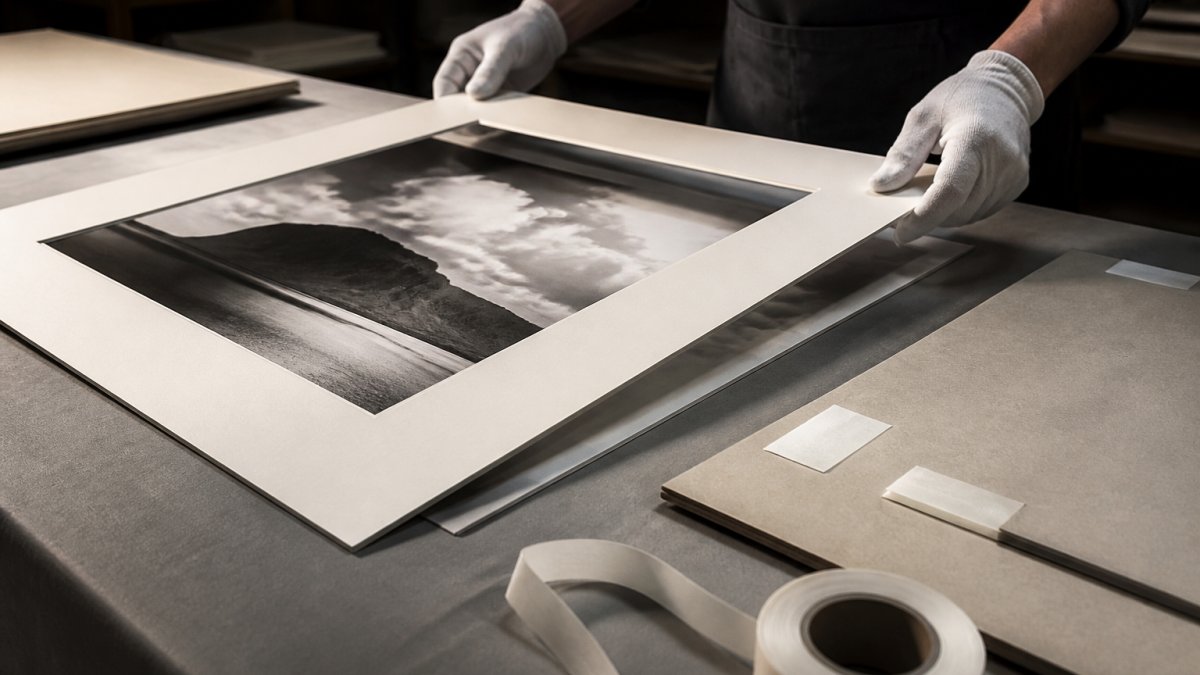
Acid-free matting benefits extend beyond appearance: it buffers the artwork against environmental acids, prevents direct contact with the glazing, and keeps the piece fully reversible for future conservation.
The best mat board is 100% cotton rag, naturally lignin-free and pH-neutral. Purified wood pulp board, often called conservation board, is a close second when buffered with calcium carbonate.
Museum-Grade UV Protection Glass and Glazing Choices
Glazing is the most misunderstood component in archival framing. It is the layer most likely to be downgraded to save money, and that downgrade is often invisible until fading has already occurred.
UV radiation does the most cumulative damage to paper and photographic prints. It is invisible, passes through window glass, and is emitted by both sunlight and fluorescent tubes.
What the Glazing Options Actually Are
Four categories of glazing are sold for framing, differing in UV filtration, weight, and cost.
Standard clear glass is soda-lime float glass. It blocks almost no UV, so it suits only decorative items with no preservation value.
UV-filtering glass is float glass with a UV-absorbing coating or interlayer.
Museum glass combines UV filtration with an anti-reflective etched or coated surface.
Matching Glazing to the Object
- Works on paper (prints, drawings, watercolors): UV-filtering glass or acrylic. Watercolors and colored inks are among the most light-sensitive media.
- Photographs: UV-filtering glazing is essential. Color photographs are especially vulnerable because their dyes break down under UV and visible light alike. No glazing blocks all visible light, so even UV-filtered photographs will eventually shift in continuous bright light.
- Textiles and quilts: UV-filtering acrylic is often preferred for its lighter weight, but the static issue means the textile must not touch the glazing.
The Trade-Offs Nobody Mentions
UV-filtering glazing reduces but does not eliminate fading. Visible light, heat, and humidity all contribute to deterioration, and no glazing blocks all of them.
Glazing also creates a microclimate inside the frame. If the frame is not properly sealed and the environment swings between humid and dry, condensation can form on the inside of the glass.
Cost scales steeply: standard glass is inexpensive, UV-filtering glass costs more, and museum glass can cost several times standard glass for the same dimensions.
| Glazing Type | UV Filtration | Weight | Scratch Resistance | Static Risk | Best For |
|---|---|---|---|---|---|
| Standard glass | Minimal | Heavy | Moderate | None | |
| UV-filtering glass | High | Heavy | Moderate | None | |
| UV-filtering acrylic | High | Light | Low | High | Large-format, oversized |
| Museum glass | Highest, with anti-reflective coating | Heavy | Moderate | None |
Reversible Mounting, Hinging, and Backing Boards
Reversible mounting is the line between conservation framing and decorative framing. A conservator can undo reversible mounting without harming the artwork; irreversible mounting permanently alters the object and removes future options.
How Hinging Works
A hinge is a small strip of material that attaches the artwork to the mat or backing board while allowing the paper to move.
The standard conservation hinge is Japanese paper adhered with wheat starch paste (Paper Hinges - Matting and Hinging Works of Art on Paper).
For photographs, archival corner pockets are often preferred because they require no adhesive on the photograph itself.
What to Avoid
- Masking tape, packing tape, and duct tape: The adhesives are acidic and migrate into paper, staining permanently and requiring a conservator to remove.
- Spray adhesive: Bonds the entire surface of the artwork to the board. Irreversible.
- Dry mounting: Uses heat-activated adhesive to bond the artwork to a board. Irreversible and common on posters and inexpensive prints. It flattens the piece but destroys its future conservation options.
Object-Specific Mounting Guidance
Different objects require different mounting approaches. Treating them all the same is a common mistake.
- Works on paper (prints, drawings, watercolors): Japanese paper hinges with wheat starch paste, attached at the top edge only, or archival corner pockets. The paper must be free to expand and contract.
- Photographs: Archival corner pockets or photo corners are safest. Avoid hinging directly on the photograph surface, especially glossy or resin-coated prints, where adhesive can leave permanent marks.
- Documents and certificates: Corner pockets or a Mylar sleeve, which protects against fingerprints and oils during handling and display.
Backing Boards and Sealing
The backing board closes the frame from behind. It blocks dust, pollutants, and moisture, supports the artwork, and provides a rigid surface for mounting.
An archival backing board is acid-free and lignin-free: acid-free foam board, corrugated plastic (such as Coroplast), or acid-free corrugated board.
Sealing the back with backing paper or foam tape completes the barrier, limiting dust and moisture and stabilizing the microclimate inside.
A Note on Frame Construction
The frame itself should be sealed at the corners and along the rabbet where the glazing meets the frame. Many inexpensive frames have gaps that allow air exchange; a conservation framer typically lines the rabbet with barrier tape or seals the frame with backing paper.
A Practical Checklist for Verifying Archival Framing Materials
You can verify archival framing materials without a chemistry lab if you know what to ask and look for. Use this checklist before you buy or commission a frame.
Questions to ask the framer or seller:
- Is the mat board 100% cotton rag or purified wood pulp, and is it lignin-free?
- Is the backing board acid-free and lignin-free, or is it standard cardboard?
- Does the glazing filter UV, and what percentage does it block?
What to inspect on a finished frame:
- No visible tape or adhesive touching the artwork
- Mat board edges are clean and uniform in color
- Print sits flat with no ripples or buckling
Maintenance and inspection schedule:
- Inspect framed pieces every 12 months for discoloration or condensation
- Keep frames out of direct sunlight and away from heating vents
- Maintain indoor humidity in a stable range, avoiding sharp swings
- If you spot staining or rippling, consult a conservator before re-framing
Conclusion
The materials behind your art matter more than the frame in front of it, and most damage happens slowly enough that buyers never see it coming. Conservation-grade matting, UV-filtering glazing, reversible mounting, and acid-free backing help keep a print intact.
At DE LA Gallery, every piece is printed and framed in-house by Jeffrey Rodriguez using verified archival materials, so you know exactly what is behind the art.
Frequently Asked Questions
What is archival framing and why does it matter?
Archival framing uses acid-free, lignin-free, and conservation-grade materials to protect artwork from deterioration. It matters because ordinary framing materials release acids and other chemicals that cause discoloration, brittleness, and fading over time. Proper archival framing with reversible mounting, acid-free matting, and UV-filtering glazing can add decades to a print's life, which is especially important for valuable fine art photography and original works on paper.
How do acid-free materials prevent art degradation?
Acid-free materials have a neutral or slightly alkaline pH, so they do not release the acids that cause paper to yellow and become brittle. Lignin-free boards remove the natural component in wood pulp that breaks down into acidic compounds. Together, these materials stop acid migration from the frame into the artwork and keep the paper stable. This is one of the core acid-free matting benefits: the mat, backing, and mounting all stay chemically inert against the art.
Does UV-protective glass really make a difference in preservation?
Yes. Ultraviolet light is a primary cause of fading and color shift in photographs and works on paper, and it comes from both direct sunlight and ordinary indoor lighting. Museum-grade UV protection glass filters the majority of UV rays, slowing fading significantly. It does not stop light damage entirely, so keep framed pieces out of direct sun. Combining UV glazing with acid-free materials gives strong protection.
How can improper framing damage a fine art print over time?
Improper framing causes damage in several ways. Acidic mats and backing boards migrate acid into the paper, causing discoloration and brittleness. Adhesive mounting can become permanent and impossible to reverse. If the artwork touches the glazing, moisture can condense and cause mold or staining. Non-UV glazing lets light fade the image. Any one of these can reduce the value of a print, and the damage is often not visible until it is advanced.