 listicle
Best Large Format Landscape Photography Prints
Table of Contents
- What Makes Large Format Landscape Photography Prints Worth the Investment
- Quick Comparison: Top Artist Galleries and Print Services
- How to Choose Large Landscape Print Sizes for Your Space
- Understanding Archival Fine-Art Prints and Longevity
- Resolution, Detail, and Image Quality for Large Prints
- How to Hang Large Photo Prints for Wall Display
- Large Photo Prints for Wall: Shipping, Returns, and Damage Protection
- Direct-from-Artist vs. Print Service: What You're Actually Paying For
- Frequently Asked Questions
Last Updated: October 17, 2026
What Makes Large Format Landscape Photography Prints Worth the Investment
Hanging a large format landscape photography print isn't just decorating, it's a statement about what you value. The scale demands attention, and the detail rewards it in ways a small print never can.
But scale alone doesn't justify the cost. Archival quality, color fidelity, and craftsmanship separate a worthwhile investment from an expensive mistake. A poorly executed large print magnifies its flaws; a well-executed one becomes a focal point for decades.
At DE LA Gallery, we've spent years refining what makes a landscape print museum-quality. The difference between a print that fades in five years and one that holds its color for fifty comes down to materials, technique, and expertise, which is why we use verified archival materials and handle printing and framing in-house.
The real question isn't whether large format landscape photography prints are worth it. It's whether you're buying from someone who understands what makes them last.
Quick Comparison: Top Artist Galleries and Print Services
The market for large format landscape photography prints splits into two camps: artist-direct galleries and print services. Your choice depends on what matters most to you.
Artist-direct galleries connect you with the photographer, their vision, technical skill, and story. Print services produce images at scale. The difference shows in everything from color accuracy to how the artist stands behind their work.
Here's what you're actually choosing between:
| Source Type | Best For | Typical Experience | Key Advantage |
|---|---|---|---|
| Artist-direct (like DE LA Gallery) | Collectors seeking one-of-a-kind work with artist input | Personalized consultation, custom sizing, artist collaboration | Direct relationship with creator; verified archival materials; customization |
| Fine-art print services | Buyers wanting gallery-quality prints of existing work | Self-service ordering, standard sizes, consistent quality | Speed, variety of sizes, established production standards |
| Limited-edition galleries | Serious collectors building curated collections | Numbered editions, artist verification, resale documentation | Investment-grade provenance; scarcity; artist reputation |
DE LA Gallery stands in the artist-direct camp, representing Jorge de la Torriente's large format landscape photography prints exclusively. You're choosing from work reflecting a specific artistic vision, with in-house printing and framing by Jeffrey Rodriguez keeping every detail under our control.
The trade-off is straightforward: artist-direct galleries offer customization and relationship; print services offer speed and choice. Most collectors find the relationship matters more for something hanging permanently on their wall.
How to Choose Large Landscape Print Sizes for Your Space
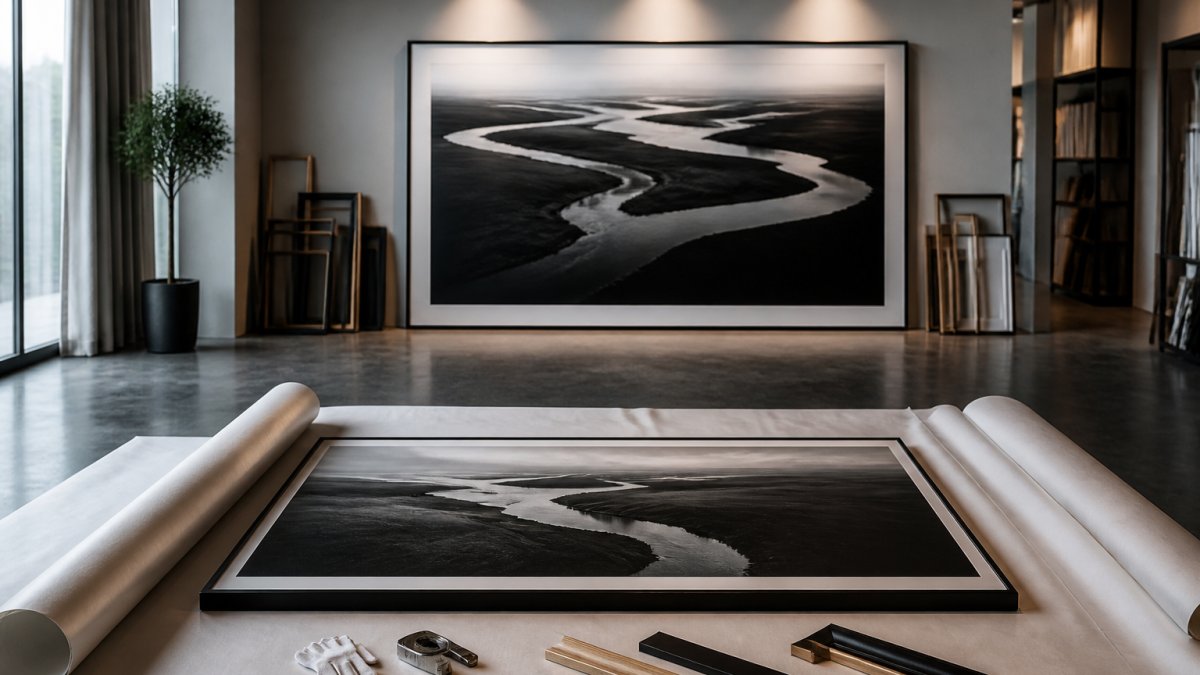
The biggest mistake buyers make with large format landscape photography prints is choosing size without measuring. A stunning 40 x 60 image online can dominate a living room in ways you didn't anticipate.
Size is about proportion, viewing distance, and how the print relates to the wall and furniture around it.
Standard Dimensions and Wall Placement Guidelines
Large landscape prints typically come in 16 x 24, 20 x 30, 24 x 36, 30 x 45, and 40 x 60 inches. Each serves a different purpose.
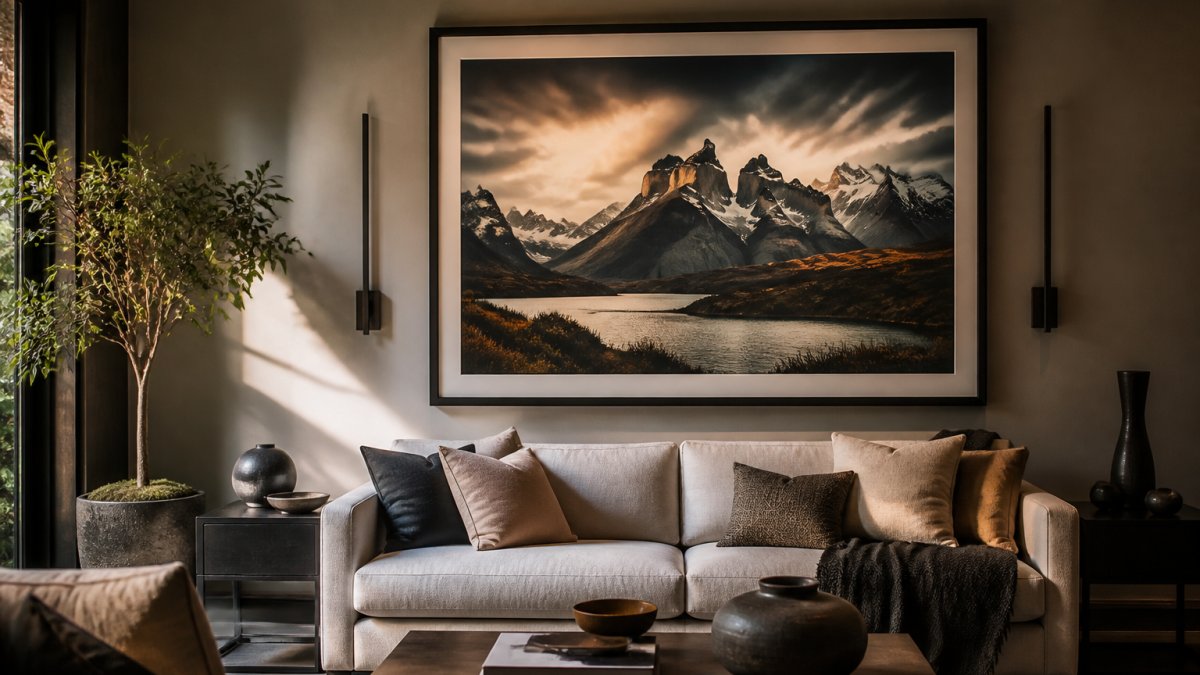
Above a sofa or bed, measure the furniture width first, your print should be roughly 50-75% of it. An 84-inch sofa pairs well with a 40 x 60 or 30 x 45. Smaller walls, hallways, powder rooms, and home offices work better with 16 x 24 or 20 x 30.
Viewing distance matters too. A 40 x 60 print should hang where people stand at least 6-8 feet away; closer feels overwhelming, farther loses the detail.
Wall color affects how your print reads. A neutral background, white, soft gray, warm beige, lets the landscape dominate, while bold colors compete with it. If your wall is already a statement, consider a smaller print or a different wall.
Understanding Archival Fine-Art Prints and Longevity
Here's what separates a print you'll treasure from one that becomes a cautionary tale: archival materials and printing process.
Archival fine-art prints are made to last 75+ years without significant fading or color shift, a testable standard, not marketing language. The Photographic Activity Test (PAT) measures how prints hold up under accelerated aging, and certified prints are rated for specific lifespans based on storage and display conditions.
Most large format landscape photography prints use one of three printing methods: inkjet (giclee), lambda (light-jet), or traditional chemical printing. Each has different longevity profiles.
Paper Types, Finishes, and Color Stability
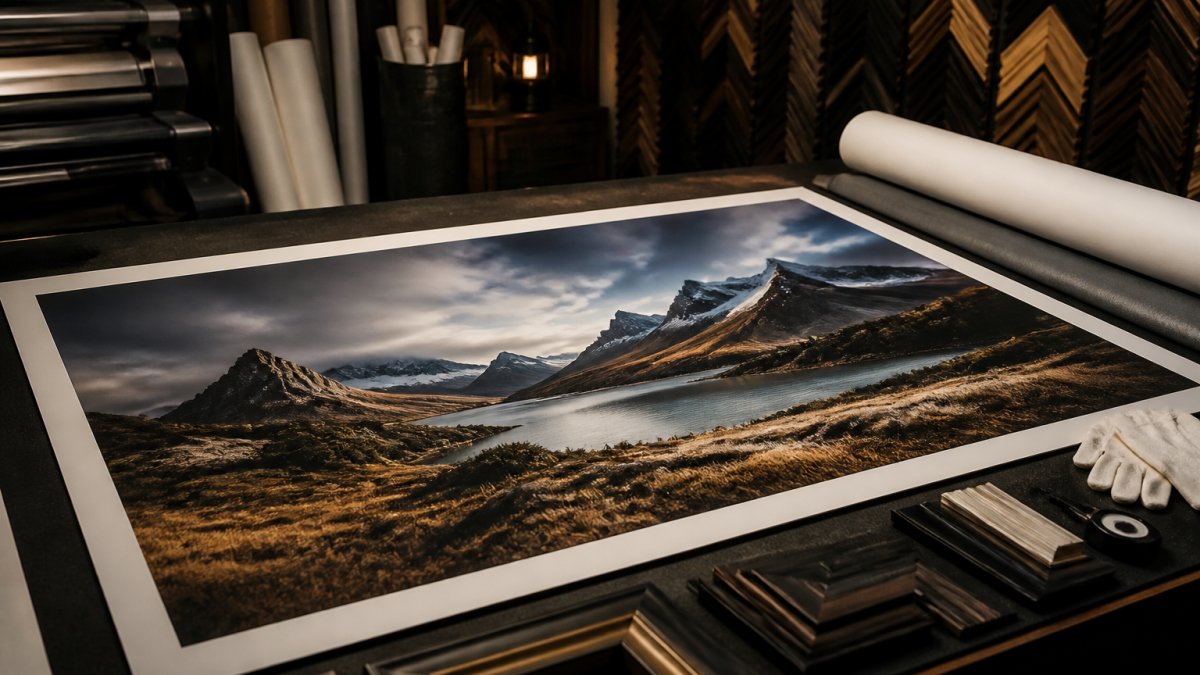
Giclee printing on fine-art paper is the most common method for large format landscape photography prints, offering excellent color range and detail. Longevity depends on the paper and ink combination: premium archival papers, cotton rag, baryta, or acid-free matte, with archival pigment inks can last 100+ years in normal display conditions.
Matte finishes hide dust and fingerprints and reduce glare in well-lit rooms. Baryta paper has a subtle sheen that enhances color depth without true gloss's reflectivity, while cotton rag delivers the most museum-like appearance with intentional texture and weight.
The paper is half the equation; ink stability is the other. Archival pigment inks resist fading far better than dye-based inks and are the only choice if you want your large format landscape photography print to hold its color for decades.
DE LA Gallery uses verified archival materials for every print we produce. We work with papers and inks rated for 100+ years of display life. That's not a promise we make lightly, it's a commitment we back with our reputation.
Resolution, Detail, and Image Quality for Large Prints
Large format landscape photography prints expose every weakness in an image.
The rule of thumb: for large prints, you need at least 300 pixels per inch (PPI) at final print size. That means a 40 x 60 print needs a file that's at least 12,000 x 18,000 pixels.
Professional photographers have an advantage here, shooting with high-resolution cameras specifically to enable large format landscape photography prints. A 40- or 100-megapixel camera captures the detail that makes a 40 x 60 print sing.
But resolution is only part of the story. A technically perfect but boring image is just boring at a larger scale.
When you're evaluating large format landscape photography prints, ask yourself: does this image reward close viewing? Can you spend five minutes looking at it and still discover something new? If yes, it's worth printing large.
How to Hang Large Photo Prints for Wall Display
Getting a large print on the wall is different from hanging a smaller piece. The weight, the visual impact, and the installation method all matter.
Mounting, Framing, and Installation Best Practices
Large format landscape photography prints need proper support. A 30 x 45 print can weigh 15-20 pounds framed; a 40 x 60 can exceed 30. A picture hook rated for 5 pounds won't do.
Use heavy-duty wall anchors, or better, mount directly into a stud. Without a stud, use toggle or molly bolts rated for at least 50 pounds, trivial cost next to a large print crashing to the floor.
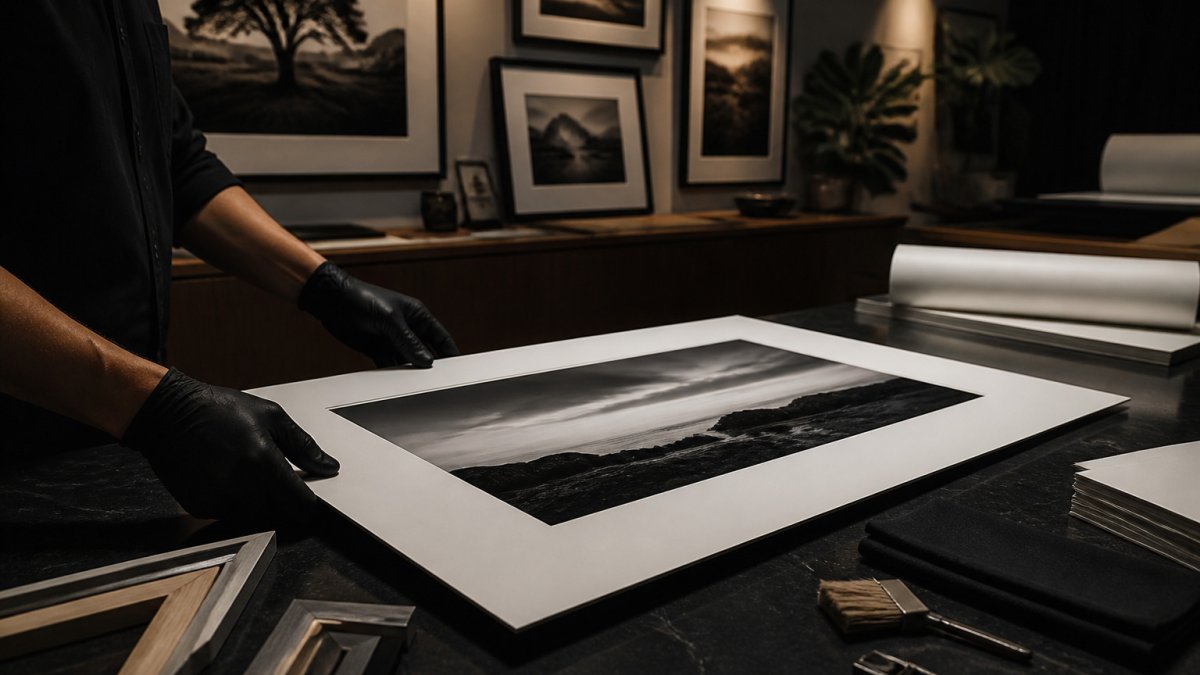
Framing matters as much as the print. A cheap frame makes an excellent print look mediocre; a quality frame, solid wood, proper rabbet, UV-protective glass or acrylic, enhances and protects it.
Matting serves aesthetic and protective functions: it creates visual breathing room and keeps the print from touching the glass, preventing deterioration. For large prints, a 2-3 inch mat on all sides is standard; some collectors prefer wider mats for a gallery aesthetic.
The framing process at DE LA Gallery includes expert consultation. Jeffrey Rodriguez works with each client to choose materials that complement their space and protect their investment. It's not an afterthought, it's part of what makes the final piece work.
Large Photo Prints for Wall: Shipping, Returns, and Damage Protection
Large format landscape photography prints are fragile in transit. A bent corner or crease in the frame can ruin the piece. Legitimate galleries take shipping seriously.
Reputable sellers pack large prints with multiple layers of protection: corner guards, cardboard backing, bubble wrap, and sturdy outer boxes. They insure shipments for full replacement value. They track packages and provide updates.
Ask about return policies before you buy. A good return policy should allow at least 30 days to inspect the print in your space under your lighting. Some galleries offer longer windows, 60 or 90 days.
Damage claims should be straightforward. You photograph the damage, report it within a specified timeframe, and the gallery either replaces the print or issues a refund.
DE LA Gallery guarantees safe delivery and handles damage claims immediately. We want you to receive your large format landscape photography print in perfect condition, and if something goes wrong, we make it right.
Direct-from-Artist vs. Print Service: What You're Actually Paying For
When you buy a large format landscape photography print directly from an artist, you're paying for more than production costs.
You're paying for the artist's vision and technical skill. Jorge de la Torriente spends years developing his eye for landscape composition, light, and moment.
You're paying for quality control. At DE LA Gallery, every print is inspected before it ships.
You're paying for relationship and customization. An artist-direct gallery can adjust sizing, framing, matting, and finish to match your space and preferences.
You're paying for archival commitment. When we use verified archival materials, we're making a 75+ year promise.
The price difference reflects these differences.
For collectors serious about their work, the artist-direct experience is worth the premium.
Choosing large format landscape photography prints means choosing between convenience and commitment. Print services offer speed and variety.
Frequently Asked Questions
What resolution do I need for a large format landscape photography print?
For large format landscape photography prints viewed from typical room distances (6-10 feet), aim for at least 150-200 DPI (dots per inch) at print size. A 40x60-inch print requires a source image of roughly 6000x9000 pixels. Professional fine-art prints often use 300 DPI for exceptional sharpness. Higher megapixel cameras (100+ megapixels) capture the detail needed for poster-sized prints without degradation. Resolution matters more for large prints because viewers stand closer; insufficient resolution becomes visible as pixelation or softness.
How do archival fine-art prints stay vibrant and fade-resistant?
Archival fine-art prints use acid-free, lignin-free papers and fade-resistant inks (pigment-based rather than dye-based) to resist color shift over decades. Cotton rag paper and baryta-coated paper are common archival substrates that resist yellowing. Professional labs use certified materials tested to ISO 18934 standards for print longevity. Direct-from-artist galleries like DE LA Gallery use verified archival materials and can provide documentation of fade-resistance guarantees. Proper framing with UV-protective glass and avoiding direct sunlight further extends print life to 75+ years.
What size landscape photography print works best above a sofa?
A landscape print above a sofa typically spans 60-80% of the sofa's width for visual balance. For a standard 84-inch sofa, a 40x60-inch or 48x72-inch print works well. Mount the center of the print at eye level (57-60 inches from the floor) when seated. Panoramic formats (wider than tall) suit horizontal wall spaces, while square formats (40x40 inches) work for accent walls. Leave 12-18 inches of wall space on each side to avoid overwhelming the room. Test placement using painter's tape before committing.
Are fine-art landscape photography prints worth the investment?
Fine-art landscape photography prints represent a long-term investment if you prioritize archival quality, artist authenticity, and emotional resonance. Museum-quality prints on archival paper with proper framing last 75+ years without fading, making them more durable than mass-produced alternatives. Direct-from-artist galleries offer limited editions and unique perspectives unavailable elsewhere. However, value depends on your priorities: if you seek affordable wall decor, standard prints suffice. Collectors and those furnishing permanent spaces benefit most from archival prints' longevity and resale potential.