 listicle
Is Luxury Large Scale Wall Art Worth the Investment?
Last Updated: October 30, 2026
Quick Summary
Luxury large scale wall art is original or limited-edition artwork produced at oversized dimensions with archival materials, and it is worth the investment because a single large piece anchors the room and makes a space feel finished. Choose archival pigment prints on acid-free paper with UV glazing, and confirm edition size and certificate of authenticity before buying.
- Oversized art should fill roughly two-thirds to three-quarters of the width of the furniture below it.
- Center artwork at eye level, about 57 to 60 inches from the floor to the middle of the piece.
- Mount heavy pieces with a French cleat or two heavy-duty D-rings into studs, never a single drywall anchor.
- Edition size is the single biggest driver of long-term value for limited edition prints.
- Open packages with the carrier present and photograph any damage before signing.
Table of Contents
- Why Luxury Large Scale Wall Art Changes a Room
- Large-Scale Art Placement: Finding the Right Wall and Proportion
- How to Hang Large Wall Art Without Damaging It
- Large-Format Landscape Photography Prints as Statement Pieces
- Archival Fine Art Photography Prints: What Makes Them Last
- Framed, Unframed, and Canvas: Choosing the Right Format
- Previewing and Buying Large Scale Wall Art Online
- Book a Private Viewing at DE LA Gallery
- Frequently Asked Questions
Why Luxury Large Scale Wall Art Changes a Room
Scale is the reason. A large piece pulls the eye across the room and makes a space feel finished. Small prints scattered on a big wall read as clutter; one bold design at full scale reads as intention.
Watch out: buying a huge piece before measuring the wall is a common mistake. A statement piece that overhangs the sofa can look out of proportion no matter how it is framed.
For a deeper walkthrough of choosing artwork by size, subject, and room, see our guide on how to choose large wall art.
Large-Scale Art Placement: Finding the Right Wall and Proportion
Large-scale art placement starts with proportion, not taste. Decide how much wall the piece should cover before you fall in love with a print, because the room sets the size.
How Much Wall Should the Art Cover?
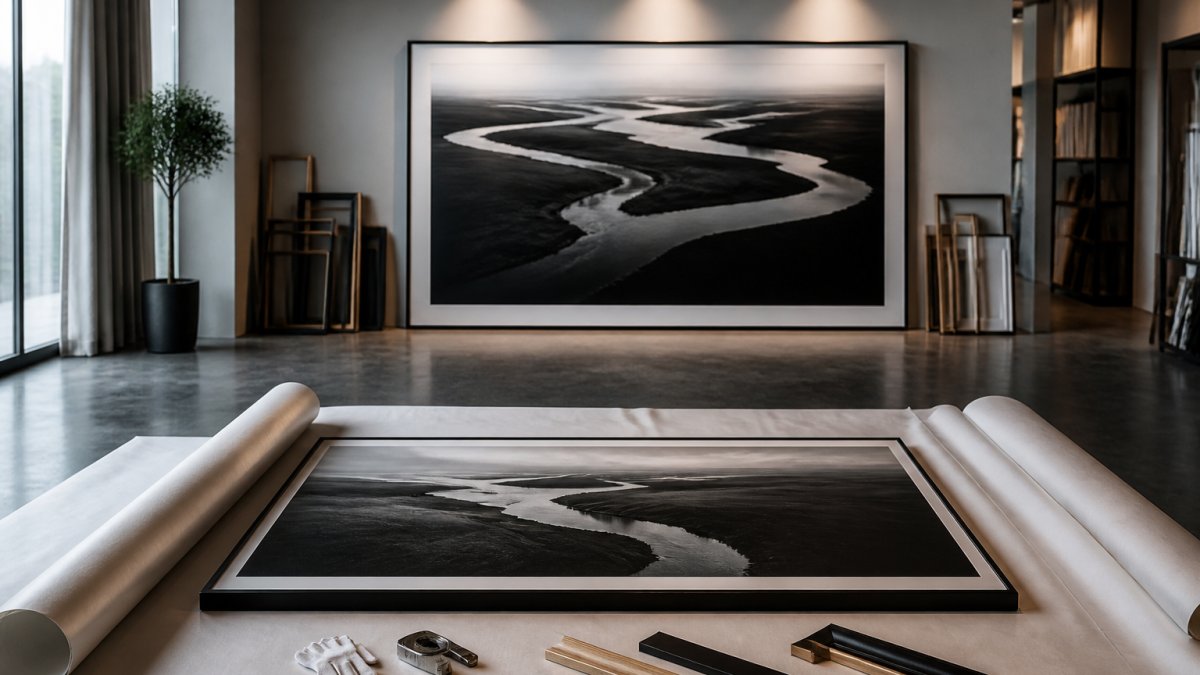
Oversized art should fill roughly two-thirds to three-quarters of the width of the furniture below it. Above a sofa, the frame spans most of the seating. Center the artwork at eye level, about 57 to 60 inches from the floor to the middle of the piece.
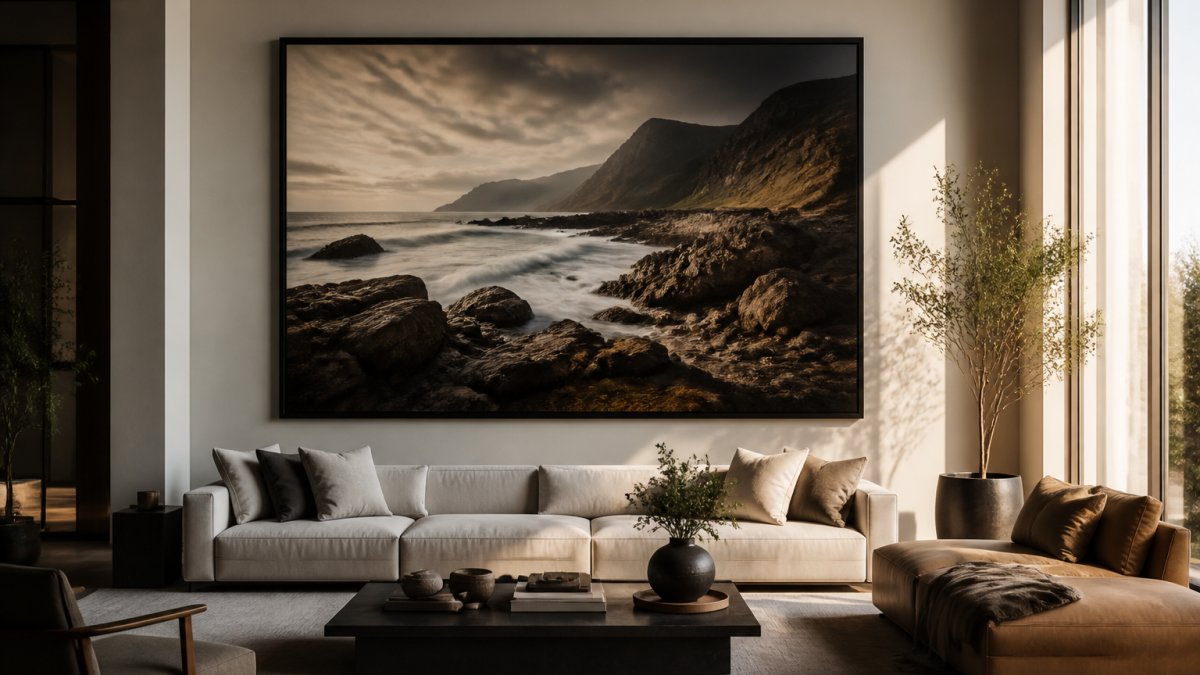
If you're matching art to a specific room, our guide on choosing art for a living room covers furniture pairing and wall-by-wall planning.
How to Hang Large Wall Art Without Damaging It
Hanging large wall art safely comes down to anchors, studs, and two people. Oversized framed art is heavy, and drywall alone will not hold it. Here is the sequence we recommend:
- Locate the studs with a stud finder and mark them in pencil.
- Choose a hanging system rated well above the piece's weight, such as a French cleat or two heavy-duty D-rings into studs.
- Measure the drop from the hanging wire to the top of the frame, then mark the hook height on the wall.
- Drill pilot holes, install anchors, and mount the hardware.
- Lift with two people, level the frame, and add felt pads at the bottom corners to protect the wall.
Watch out: skipping the stud and relying on a single drywall anchor is how framed art ends up on the floor.
Large-Format Landscape Photography Prints as Statement Pieces
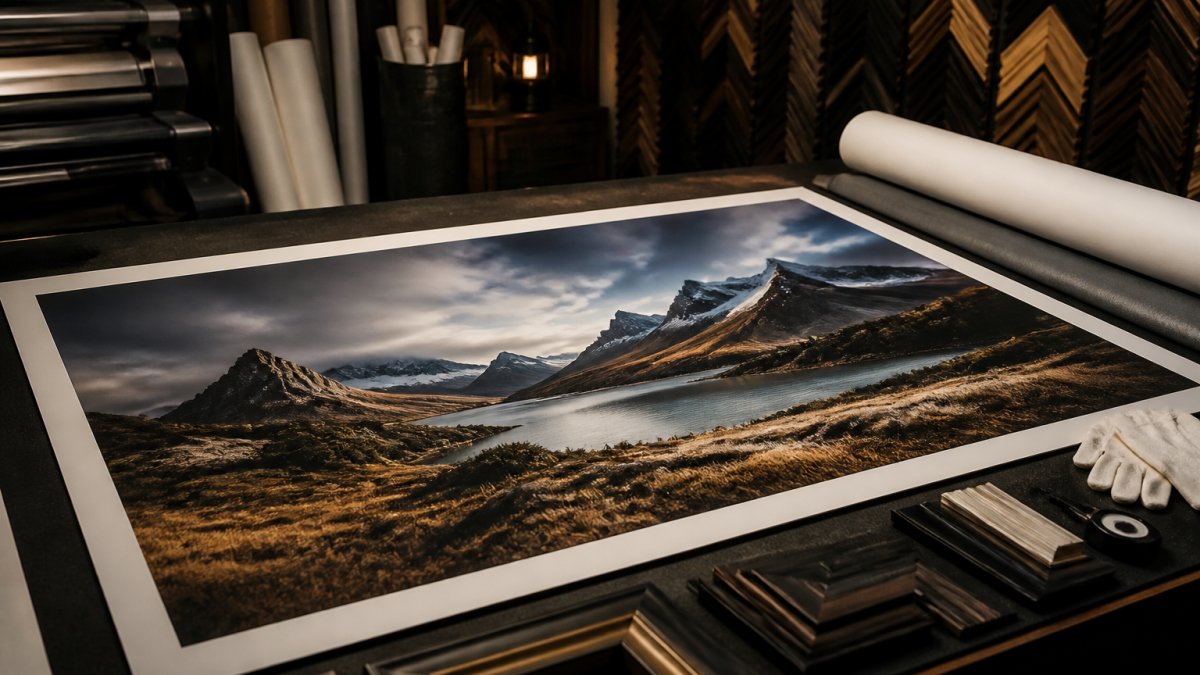
Large-format landscape photography prints work as statement pieces because a single dramatic scene, printed big, gives a room a mood that abstract decor rarely matches. A moody coastline or misty forest at full scale turns a blank wall into a window.
What most guides miss is that the subject has to survive enlargement. A composition with one strong horizon and open sky holds up at six feet wide; a cluttered scene turns to noise. Choose the image for how it will read across the room, not on a phone screen.
For curated options, browse our roundup of large-format landscape photography prints.
Archival Fine Art Photography Prints: What Makes Them Last
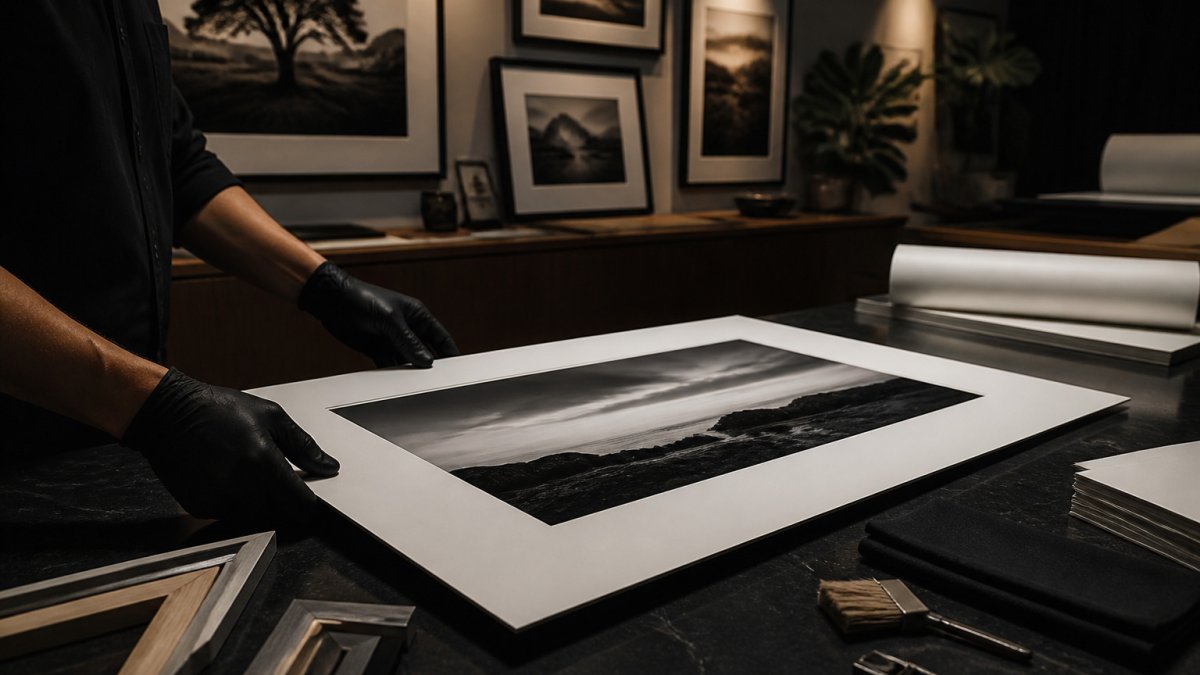
Archival fine art photography prints are printed with pigment inks on acid-free paper and framed with materials that will not yellow, fade, or break down over time. That combination separates a print that lasts decades from one that looks washed out in a few years. If longevity is the point, the paper, ink, and glazing matter as much as the image.
At DE LA Gallery, we use verified archival materials and frame in house with expert framing by Jeffrey Rodriguez.
For guidance on value and longevity, read our rules for investing in limited edition landscape photography.
Framed, Unframed, and Canvas: Choosing the Right Format
Framed art suits collectors who want a finished, gallery look, while unframed prints and canvas offer a lighter, contemporary feel. But at luxury scale, format is a materials decision that drives weight, longevity, price, and how the piece reads across a room. Two prints of the same image can differ by thousands of dollars and decades of usable life depending on what happens after the ink hits the paper.
What Actually Separates Premium From Generic Large-Format Decor
Luxury large scale wall art is built on four components, each a place to check quality:
- Paper or substrate. Archival pigment prints belong on acid-free paper, which resists the yellowing and brittleness that cheaper papers can develop.
- Ink. Pigment inks resist fading far better than dye inks. Ask for the permanence rating of the specific ink and paper used for your piece.
- Glazing. Acrylic is lighter and safer over large pieces than glass, and UV-filtering glazing helps protect the print from fading.
- Frame and mounting. A sturdy frame with a rigid backing board helps hold the print flat over time.
Format-by-Format Trade-offs
| Format | What It Is | Best For | Trade-off |
|---|---|---|---|
| Framed archival print | Pigment print on cotton-rag paper, matted, under UV acrylic in a hardwood frame | Formal living rooms, collectors, pieces meant to be handed down | Heaviest option; needs stud or cleat mounting; highest cost |
| Unframed archival print | Same print, shipped rolled or flat without frame | Minimalist spaces, buyers who want to choose their own framing | Must be framed before hanging; handling risk on large sheets |
| Gallery-wrapped canvas | Pigment print on poly-cotton canvas, stretched over a solid wood stretcher bar | Contemporary rooms, casual spaces, lighter weight | Canvas can relax over time; edges need a clean wrap; less formal |
| Acrylic face-mount | Print bonded behind optically clear acrylic | Modern, high-gloss statement walls | Reflects light and windows; heavier than canvas; premium price |
| Diptych or triptych | One image split across two or three panels | Very wide walls, stairwells, above long sectionals | Alignment must be exact; harder to resell as a single piece |
Best for: a single focal point in a large room, framed archival print with UV acrylic. Skip if: you plan to rearrange art often or move frequently; unframed or canvas is easier to handle.
How Format Affects Price at Large Scale
Format affects price, and pricing depends on size, format, framing, and edition status. For current pricing or a quote, visit the DE LA Gallery website.
For guidance on value and longevity, read our rules for investing in limited edition landscape photography.
Previewing and Buying Large Scale Wall Art Online
Buying large scale wall art online works when you can preview the piece in your own space first and when the seller is transparent about editions, price, shipping, and installation. Screens distort color, and a print that looks right on a laptop can read differently on your wall. That is why we built augmented reality previews into our site: point your phone at the wall and see the artwork at true scale before you commit.
Know What You Are Buying: Original, Limited Edition, or Reproduction
Three product types are common in online art listings, and the difference matters for both value and care:
- Original. A one-of-a-kind work, often signed and accompanied by a certificate of authenticity. Pricing reflects uniqueness, and there is no replacement if it is damaged.
- Limited edition. A fixed number of prints from one image, typically numbered and signed, with a stated edition size and often a certificate of authenticity. Once the edition sells out, no more are printed at that size and medium. Edition size is the single biggest driver of long-term value.
- Open-edition reproduction. Unlimited printing with no numbering. Fine for decoration, but it will not hold collector value and may be printed on lower-grade materials.
Ask for the edition size, the signature and numbering, and the certificate of authenticity in writing before you buy. A gallery that prints and frames in house can usually tell you exactly which edition number you are reserving.
What Large-Scale Art Actually Costs
Prices for luxury large scale wall art depend on size, framing, and edition status. For current pricing on DE LA Gallery pieces, visit the website or request a quote.
When you compare listings, normalize by size and materials, since the same image can be offered in different formats.
Shipping, Delivery, and Installation of Oversized Pieces
Oversized art is a logistics purchase as much as an aesthetic one. A few practical points most listings bury:
- Inspection on arrival. Open the package with the carrier present and photograph any damage before signing. Damage claims are easier when documented at delivery.
- Hardware. Use hanging hardware rated for the piece's weight, mounted into studs where possible.
- Two-person lift. Large framed pieces are safer to lift and hang with two people.
Care and Long-Term Preservation
Keep large pieces out of direct sunlight and away from heat sources and humid rooms. Dust framed art with a dry microfiber cloth rather than spray cleaners, which can seep behind glazing. Acrylic glazing scratches easily, so avoid abrasive cloths. Canvas should be dusted gently and kept away from direct handling, since skin oils can stain the surface.
We also sell directly from the artist, so there is no middleman between you and the work. Our website offers secure checkout.
When you're ready to browse, our limited edition prints collection shows what is currently available.
Book a Private Viewing at DE LA Gallery
Choosing a piece this large is easier in person. Visit our Key West gallery to see the work before you decide. Our gallery represents photographer Jorge de la Torriente exclusively, with in-house printing and framing.
Visit the DE LA Gallery website to explore museum-quality large-format photography.
Frequently Asked Questions
How do you choose the right size for luxury large scale wall art?
Measure the wall and the furniture below it. A common guideline is that art should cover about 60 to 75 percent of the width of a sofa or console. For a large scale wall art piece above a king bed, aim for a width that is at least two-thirds of the headboard. If you are unsure, use the augmented reality preview on the DE LA Gallery site to see the piece at true scale before you commit.
How high should you hang oversized wall art?
The center of the artwork should sit at eye level, roughly 57 to 60 inches from the floor. In rooms with high ceilings, you may need to raise it slightly so it does not feel lost, but keep the relationship to the furniture below. For a dining room or hallway where people stand, a few inches higher works. Always use a level and measure twice before drilling, especially with heavy framed pieces.
How do you protect large-format art from fading?
Fading comes from UV light and humidity. Choose archival fine art photography prints that use pigment inks on acid-free paper and are framed with UV-filtering glazing. Keep the piece out of direct sunlight and away from heat sources. DE LA Gallery uses verified archival materials and in-house framing, so you can ask directly about the specific papers, inks, and glazing used for the piece you are considering.
Can you preview large wall art in your room before buying?
Yes. DE LA Gallery supports augmented reality previews so you can see how a piece looks on your actual wall through your phone or tablet. This helps you judge scale, color, and placement without guessing. If you are still unsure, visit our Key West gallery to see the work before you order.
What makes archival fine art photography prints different from standard prints?
Archival prints use pigment-based inks and acid-free papers designed to resist fading for decades under proper conditions. Archival prints use pigment-based inks and acid-free papers designed to resist fading. Ask the gallery to confirm the paper and ink used for the piece you are considering.