 how-to
7 Rules for Investing in Limited Edition Landscape Photography
Last Updated: October 28, 2026
Quick Summary
Investing in limited edition landscape photography means buying numbered, signed prints from a fixed print run that the photographer stops reproducing at a set number, creating verifiable scarcity. Scarcity alone doesn't create value, so evaluate the image, the photographer's reputation, archival materials, and the certificate of authenticity and provenance before you commit.
- A photographer commits to a numbered edition and stops printing at that number, making each signed print a known quantity.
- Edition size tells you about supply, not demand, and demand is what actually moves market value.
- Open editions can be reprinted indefinitely, which removes scarcity entirely.
- Artist reputation drives collector demand more than any other factor, so research exhibition history and credentials.
- Resale timing and liquidity are not guaranteed, so treat resale value as a possible outcome, not a plan.
Table of Contents
- Why Limited Edition Landscape Photography Attracts Collectors
- How Photography Print Edition Size Shapes Scarcity and Value
- How to Evaluate Fine Art Photography Before You Commit
- How to Identify Archival Quality Prints
- The Photography Print Certificate of Authenticity and Provenance
- The Due Diligence Checklist: Resale Mechanics, Costs, and Risks
- Building Your Collection with DE LA Gallery
- Frequently Asked Questions
Why Limited Edition Landscape Photography Attracts Collectors
Investing in limited edition landscape photography appeals to collectors for one reason: a fixed print run creates scarcity you can verify. When a photographer commits to a numbered edition and stops printing at that number, each signed print becomes a known quantity rather than an endlessly reproduced image.
One buyer may want a large-format statement piece for a living room wall. Another may want a work with documented archival materials. Buyers may care about edition size, print quality, and provenance.
Landscape and nature photography can carry particular weight for collectors. A dramatic coastline or mountain range may connect emotionally with a viewer. Wildlife photography can do the same.
Here's the honest part most guides skip: scarcity alone doesn't create value. A tiny edition of a forgettable image is still a forgettable image. Scarcity only matters when it sits on top of quality, reputation, and documentation.
How Photography Print Edition Size Shapes Scarcity and Value
Photography print edition size is the total number of prints a photographer authorizes from a given image. A smaller edition may be harder to find on the secondary market than a larger one.
Small Editions vs. Large Editions: What the Numbers Mean
Small editions may appeal to collectors who want exclusivity. Fewer prints mean fewer examples of the image exist.
Larger editions mean more prints exist.
A common mistake is assuming a low number guarantees appreciation. It doesn't. Edition size tells you about supply. It tells you nothing about demand, and demand is what actually moves market value.
Tracking Editions Across Sizes and Formats
Watch for editions split across formats. A photographer might release separate editions in different formats. Ask how the editions are counted and what the total run is.
Ask the gallery or artist for the full breakdown in writing. If the answer is vague, treat that as a warning sign.
How to Evaluate Fine Art Photography Before You Commit
Evaluating fine art photography comes down to four tests: the image itself, the photographer's trajectory, the print's materials, and the paperwork behind it. Skip any one and you're guessing.
Start with the image. Would you hang it if it were worth nothing? If the answer is no, the investment case is weak. Collectible artwork should work on your wall first and on a balance sheet second.
Then check the print run. Is it an open edition or a numbered print? Open editions can be reprinted indefinitely, which removes scarcity entirely. A signed print from a closed run is a different object.
Photographer Reputation and Career Trajectory
Artist reputation drives collector demand more than any other factor. A photographer's gallery representation, museum placements, or awards may provide information buyers can research.
Career trajectory matters too. An emerging photographer and an established name may present different considerations for a buyer.
Reputation can be researched. Look for exhibition history, published work, and professional credentials. DE LA Gallery represents photographer Jorge de la Torriente, a Hasselblad Master.
Before committing to a print, run through these four tests in order.
| Test | What to check | Why it matters |
|---|---|---|
| The image itself | Would you hang it if it were worth nothing? | Collectible artwork should work on your wall first |
| The print run | Open edition or numbered print? | Open editions can be reprinted indefinitely, removing scarcity |
| Photographer reputation | Gallery representation, museum placements, awards, exhibition history | Artist reputation drives collector demand more than any other factor |
| The paperwork | Certificate of authenticity and provenance | Records help document a work's history |
How to Identify Archival Quality Prints
Archival quality prints may use pigment-based inks and acid-free papers. Materials are one factor to consider when evaluating a print.
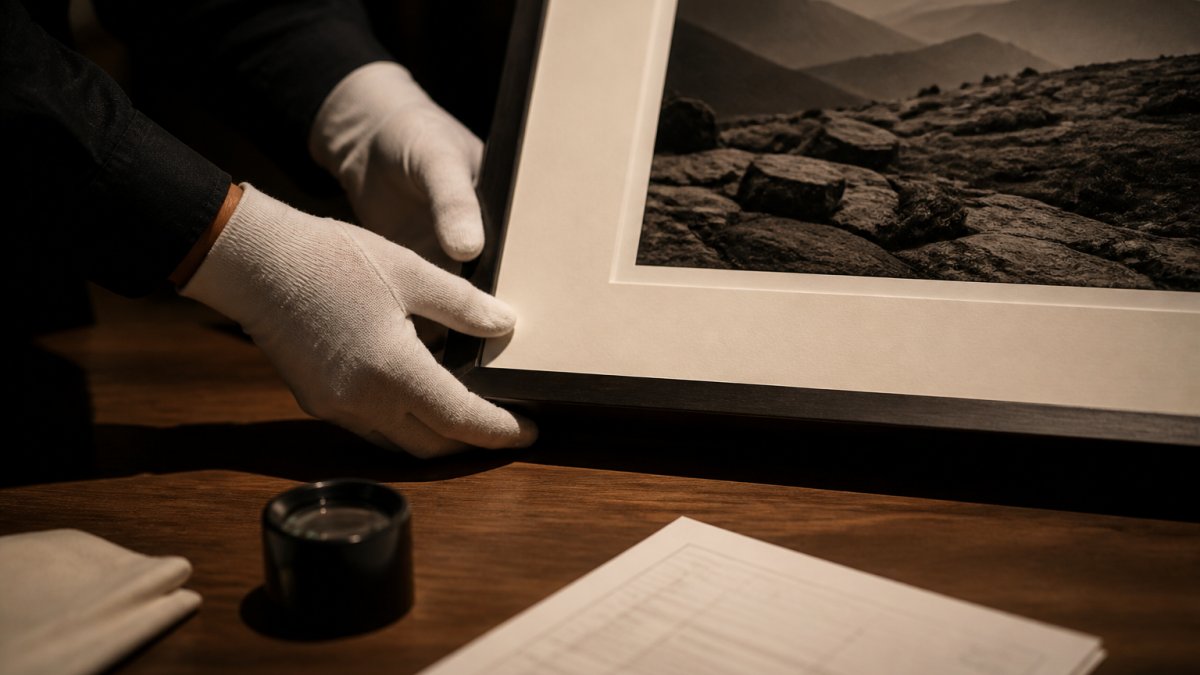
Ask about the materials used in the print and framing before you buy.
Ask the seller about the materials used in the print. For a deeper breakdown, our guide on how to identify archival quality prints walks through the specifics, and the comparison of archival versus non-archival art prints explains what actually lasts.
Why the Materials Matter Beyond the Label
Materials and framing are factors to consider when evaluating a print.
Ask the seller about the framing materials and get the details in writing.
How Condition and Display Affect Value
Display and storage conditions are factors to consider when caring for a print.
Condition may be a consideration in resale. Keep relevant documentation about the artwork and its condition.
The Photography Print Certificate of Authenticity and Provenance
A photography print certificate of authenticity may identify details about a work. Provenance is the paper trail showing who has owned the work (What Is Provenance?).
Together, these records can help document a work's history.
Keep relevant documentation with the print.
The Due Diligence Checklist: Resale Mechanics, Costs, and Risks
Before you commit, consider asking about the edition size, the photographer's history, print and framing materials, documentation, and the gallery's policies.
What Reselling Actually Involves
Resale may involve different channels, costs, and timelines.
Resale may involve costs. Ask about any applicable terms before listing a work.
Resale timing and liquidity are not guaranteed, so you cannot assume you can convert a print to cash on a chosen date.
A financial return is not guaranteed. Treat resale value as a possible outcome, not a plan.
Conservation, Storage, and Insurance
Condition drives resale value more than most buyers realize. A print with fading, foxing, or a warped frame sells at a discount or not at all, and a missing certificate compounds the problem. Treat the physical object as part of the investment.
Consider display and storage conditions when caring for a print.
Consider how you want to document the artwork and its condition. Our collector's guide to preventing fine art fading covers storage and display in more detail.
Building Your Collection with DE LA Gallery
When considering a purchase, ask the questions that matter to you.
DE LA Gallery offers a direct-from-artist experience for acquiring fine art photography by Jorge de la Torriente. The gallery uses in-house printing and expert framing by Jeffrey Rodriguez, with verified archival materials, and supports augmented reality for live art previews. You can shop securely online or visit the gallery.
If you're weighing whether editions are a sound purchase, our guide on whether limited edition photography is worth it covers the value case in depth. When you're ready to act, you can view the available limited edition D-3 work and see the print details for yourself.
Frequently Asked Questions
Are limited edition landscape photographs a good investment?
A financial return is not guaranteed. Treat a limited edition photography purchase as art you want to live with first, and an asset second.
Does edition size affect the value of a photograph?
Edition size describes the number of prints in an edition. Ask how the edition is counted and what the total run is.
How can you verify that a limited edition photograph is authentic?
Ask what documentation is available for the photograph and its edition.
How should you care for and display a fine art photography print?
Consider display conditions and how you want to document the artwork.
The hardest part of collecting isn't finding a beautiful image. It's knowing whether the print, the paperwork, and the edition behind it will hold up years from now. DE LA Gallery closes that gap with direct-from-artist access, in-house printing and framing, and verified archival materials on every piece. Get started with DE LA Gallery and add a museum-quality landscape to your collection with confidence.