 how-to
How to Identify Archival Quality Prints: 2026 Guide
Table of Contents
- What Makes a Print Archival Quality?
- Archival Pigment Ink vs Dye Ink: Which Lasts Longer?
- Acid-Free Paper Standards for Fine Art: What to Look For
- Giclée Print Authentication: Certificates and Watermarks
- How to Test Print Quality at Home: DIY Methods
- Certifications and Logos That Signal True Archival Quality
- Environmental Impact of Archival Materials
- Frequently Asked Questions
Last Updated: September 30, 2026
What Makes a Print Archival Quality?
An archival quality print is a fine art reproduction made with pigment-based inks, acid-free and lignin-free paper, and a professional printing method built to resist fading for decades. At DE LA Gallery, we utilize verified archival materials for our fine art photography. This guide shows you how to identify archival quality prints before you spend money on one.
Most buyers learn this the hard way.
The Three Pillars: Ink, Paper, and Printing Method
Every archival print rests on three choices:
- Ink: pigment-based, not dye-based
- Paper: acid-free, lignin-free, and pH neutral
- Method: a professional inkjet process using a calibrated color profile
Get all three right and the print holds its color for generations. Miss one and the whole piece degrades faster than it should.
Archival Pigment Ink vs Dye Ink: Which Lasts Longer?
Pigment ink lasts dramatically longer than dye ink. Pigment particles sit on the paper surface and resist fading from light and air, while dye molecules soak into the coating and break down faster.
Here is the practical difference:
| Feature | Pigment Ink | Dye Ink |
|---|---|---|
| Fade resistance | High, decades under glass | Low to moderate |
| Color gamut | Slightly narrower, deeper blacks | Wider, more vivid |
| Water resistance | Strong once dry | Weak |
| Best for | Fine art reproduction, giclée | Snapshots, proofs, posters |
Acid-Free Paper Standards for Fine Art: What to Look For
Acid-free paper is the baseline for any print meant to last. It has a neutral or slightly alkaline pH, so it will not turn yellow or brittle over time.
- Acid-free and pH neutral
- Lignin-free (lignin is the compound in wood pulp that yellows)
- Buffered with calcium carbonate to absorb airborne acids
- Cotton rag or alpha-cellulose fiber, not standard wood pulp
Why Lignin-Free and pH-Neutral Matter
Lignin is what makes newsprint crumble and yellow. If it stays in the paper, it keeps reacting with light and air for years.
Giclée Print Authentication: Certificates and Watermarks
A giclée is a fine art print made with a professional inkjet printer using pigment inks on archival substrate. The word signals method, not magic. Anyone can use it, so authentication matters.
Ask for:
- A certificate of authenticity naming the artist, title, edition size, and print number
- The paper brand and weight listed on the certificate
- A watermark or signature on the print or its border
- The printer and ink set used
How to Test Print Quality at Home: DIY Methods
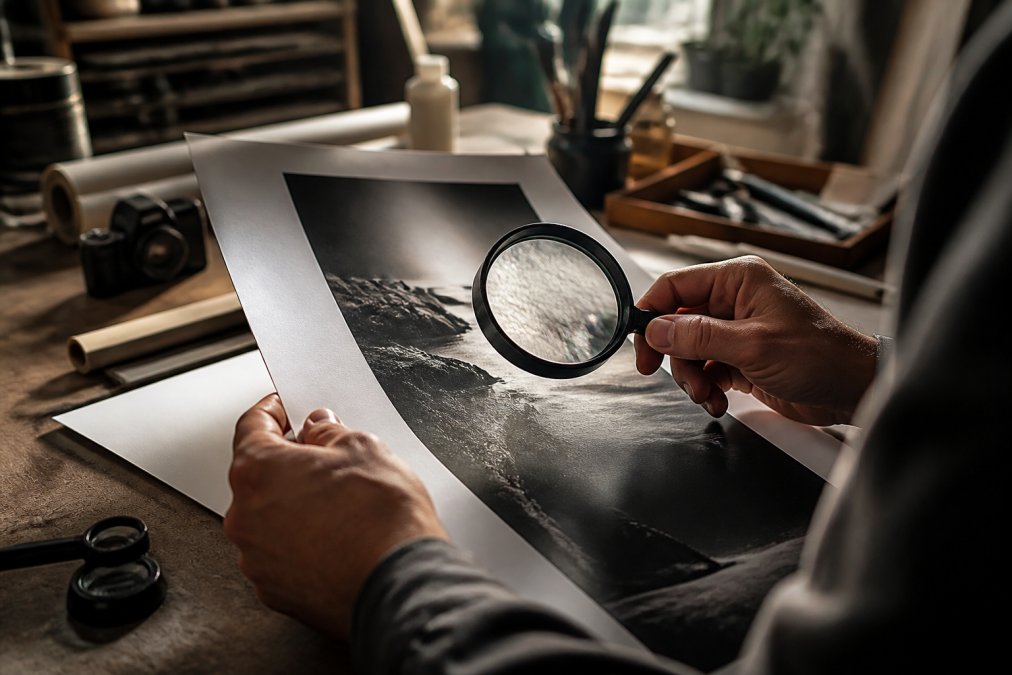
Most guides stop at theory. This section gives you a repeatable procedure you can run with tools you already own. None of these tests damage the artwork if you follow the placement rules.
What You Need
- A phone with a macro lens or a 10x jeweler's loupe
- A clean cotton swab and a small cup of water
- A UV flashlight or a bright window with indirect daylight
- A soft pencil (for the edge test only)
Test 1: The Magnifier Test (Ink Type)
Hold the loupe or phone macro lens about half an inch from a mid-tone area of the print. Pigment prints show a fine, slightly granular dot pattern where the particles sit on the paper surface. Dye prints look smooth and continuous because the color has soaked into the coating.
Test 2: The Edge Test (Fiber Type)
Look at the cut edge of the sheet under the same loupe. Cotton rag and alpha-cellulose papers show soft, frayed fibers. Wood-pulp and coated stocks show a clean, hard, almost plastic edge.
Test 3: The OBA Glow Test (Optical Brighteners)
Shine a UV flashlight across the unprinted border. Optical brightening agents fluoresce blue-white under UV. Archival papers without OBAs stay warm and dull.
Test 4: The Water Drop Test (Ink Binder)
Touch a damp, not dripping, cotton swab to a hidden corner or the back margin. Wait ten seconds. Pigment ink holds its shape because the binder sits on the surface. Dye ink wicks into the coating and bleeds outward.
Test 5: The Smell Test (Coatings)
Hold the unprinted back of the sheet close to your nose. Archival papers smell faintly of cotton or paper fiber. Cheap coated stocks give off a sharp chemical or vinegar odor from residual solvents and acidic sizing.
Test 6: The Pencil Edge Test (Surface Sizing)
Lightly drag a soft pencil along the unprinted border. Archival papers take graphite evenly because the surface sizing is consistent. Over-coated or under-sized papers grab unevenly or smear.
Pass: even, controllable line. Fail: patchy grab or smearing.
How to Score the Results
Run all six tests.
These six checks take about ten minutes and separate a true archival print from a poster in disguise.
Certifications and Logos That Signal True Archival Quality
Standardized logos do more work than marketing copy because a third party tested the materials against a published standard. But not all marks mean the same thing, and some are frequently misused on product pages. Here is what each one actually certifies and how to verify it.
ISO 9706, Paper Permanence
ISO 9706 is the international standard for paper intended for documents and records that must last. It sets limits on lignin content, requires a minimum alkaline reserve (buffering), and caps certain harmful residues. When you see it on a spec sheet, it means the paper itself was tested for aging resistance, not the print, and not the ink.
ANSI/NISO Z39.48, Permanent Paper for Publications
The American National Standards Institute and the National Information Standards Organization publish Z39.48, which covers permanent paper for published and recorded materials (ANSI/NISO Z39.48-1992 (R2009) Permanence of Paper for Publications and Documents in...). It overlaps with ISO 9706 but is the standard most often cited by libraries and archives in the United States.
FSC Certification, Fiber Sourcing
Forest Stewardship Council certification is about where the fiber came from, not how long the print will last. It confirms the pulp was sourced from responsibly managed forests. It is a sustainability mark, not an archival mark. A paper can be FSC-certified and still fail ISO 9706.
OBA-Free Labels, Optical Brightener Disclosure
"OBA-free" is not a single certifying body. It is a disclosure that the paper contains no optical brightening agents. Because there is no universal registry, the claim is only as good as the mill's spec sheet. Cross-check it with the UV glow test in the previous section.
What These Marks Do Not Cover
None of these certifications cover the ink, the printer, or the printing process. A print on ISO 9706 paper can still be made with dye ink and fade in a few years. Archival quality requires the paper standard and the pigment ink together. Even the most stable pigment prints remain vulnerable to environmental contaminants and light exposure without the protective barrier provided by archival quality framing.
FSC certificate database lookup
Environmental Impact of Archival Materials
A few points worth knowing:
- FSC-certified paper supports responsible forestry
- Pigment inks last longer, so fewer reprints end up in landfills
- OBA-free papers skip the chemical brighteners that complicate recycling
- Proper framing extends a print's life and delays replacement
Buying once and keeping it for decades is the greener choice. Cheap prints get replaced, and that cycle adds up.
Frequently Asked Questions
What does it mean for a print to be archival quality?
Archival quality means a print is made with materials and processes designed to resist fading and deterioration for decades. This typically involves pigment-based inks, acid-free and lignin-free paper, and printing methods like giclée that meet museum-grade standards, making them suitable for fine art reproduction and long-term collections.
How can I tell if a print uses archival pigment ink vs dye ink?
Pigment inks sit on the surface of the paper, while dye inks soak into the fibers. You can also check the certificate of authenticity or ask the seller directly. Pigment inks are far more resistant to UV light and fading, which is why they are the standard for archival fine art prints.
Is archival the same as acid-free?
No. Acid-free refers only to the paper's pH level, meaning it won't yellow or become brittle over time. Archival is a broader term that includes acid-free paper, but also requires pigment inks, lignin-free materials, and printing methods that meet conservation standards. A print can be on acid-free paper but still fail archival quality if it uses dye-based inks or lacks proper lightfastness.
What should I look for in giclée print authentication?
Authentic giclée prints should come with a certificate of authenticity signed by the artist or publisher, detailing the edition size, printing method, ink type, and paper used. The print itself may have a watermark, embossed seal, or signature. Reputable sellers provide full transparency about materials and often include a registration number. If authentication is vague or missing, treat it as a red flag.
Archival quality is not a mystery. It is pigment ink, acid-free paper, and a printing method you can verify. The challenge is finding a seller who will show you all three.
At DE LA Gallery, every print is made in-house with verified archival materials, framed by hand, and shipped with full documentation. You can preview each piece in your own space with augmented reality before you buy. Explore the collection at DE LA Gallery and invest in art built to last.