 listicle
Is Buying Fine Art Photography for Your Office Worth It?
Last Updated: November 4, 2026
Quick Summary
Buying fine art photography for your office is worth it because gallery-standard prints signal taste, stability, and attention to detail to clients before a word is spoken. Match each piece to the room's job, size it to roughly two-thirds of the wall width, and confirm commercial-use rights in writing before you buy.
- One strong large print beats five forgettable ones on office walls.
- A single statement piece should fill roughly two-thirds of the available wall width.
- Center artwork at eye level, roughly 57 to 60 inches from the floor.
- A standard artwork purchase typically covers display in your own space only.
- Verify the seller, edition details, materials, and return policy before buying online.
Table of Contents
- Why Fine Art Photography Prints Belong in a Professional Office
- How to Choose Office Wall Art Photography by Room and Audience
- Large-Format Landscape Photography Prints That Anchor a Room
- Matching Photography Styles to Your Workplace: From Abstract to Black-and-White
- Print Formats, Framing, and Archival Quality: What Your Money Buys
- Sizing, Placement, Glare, and Long-Term Care for Office Walls
- Licensing, Editions, and Budget Planning for Business Buyers
- How to Buy Photography Prints Online Without Getting Burned
- Frequently Asked Questions
Why Fine Art Photography Prints Belong in a Professional Office
Fine art photography is original or limited-edition photographic artwork printed to gallery standards, and it changes how a room feels the moment someone walks in. A single large-format piece can transform reception areas and executive suites. Bare walls read as temporary; curated walls read as established.
That is the practical case for buying fine art photography for office walls. Clients form impressions in seconds, and artwork signals taste, stability, and attention to detail before a word is spoken. A well-chosen photographic print also gives staff something human to look at, which matters in rooms where people spend most of their waking hours.
Below, we break down how to choose, size, frame, license, and budget for artwork that earns its wall space.
How to Choose Office Wall Art Photography by Room and Audience
Match the artwork to the room's job, not to your personal favorite image. A reception wall greets strangers; a boardroom persuades decision-makers; a focus corridor calms people between meetings.
Start with the audience. For client-facing spaces, choose broad, confident imagery: dramatic landscapes, refined architectural photography, or clean abstract work. For internal spaces, quieter pieces work better, including black-and-white photography and nature photography.
A simple decision framework:
- Reception and lobby: one large statement piece, warm and welcoming
- Boardroom: landscape photography or architectural photography with a calm palette
- Executive offices: limited-edition prints with a personal point of view
- Hallways and focus areas: smaller black-and-white photography in a series
Keep the count low. One strong large print beats five forgettable ones.
Large-Format Landscape Photography Prints That Anchor a Room
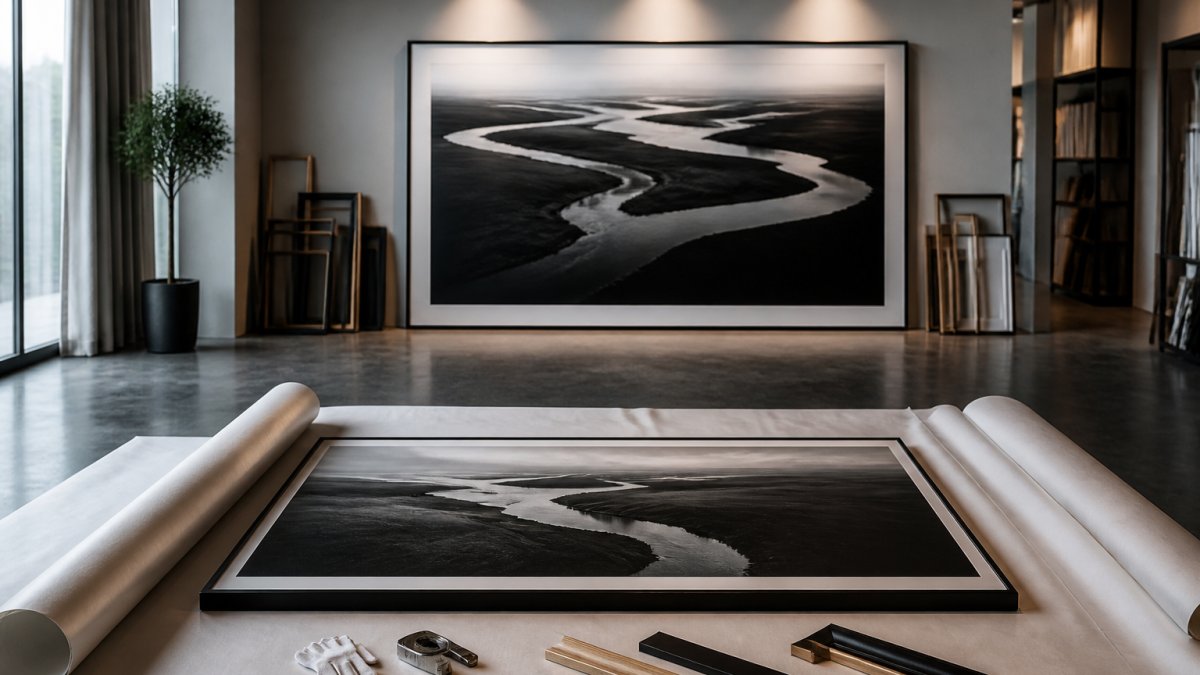
Large-format landscape photography prints work as anchors because scale creates a focal point, and landscape imagery carries a calm authority that suits professional settings. For curated examples, see the best large format landscape photography prints. Hang one behind the desk or reception console and the room gains a center of gravity. A statement piece like Room with a View shows how a single large-format print can anchor an office room.
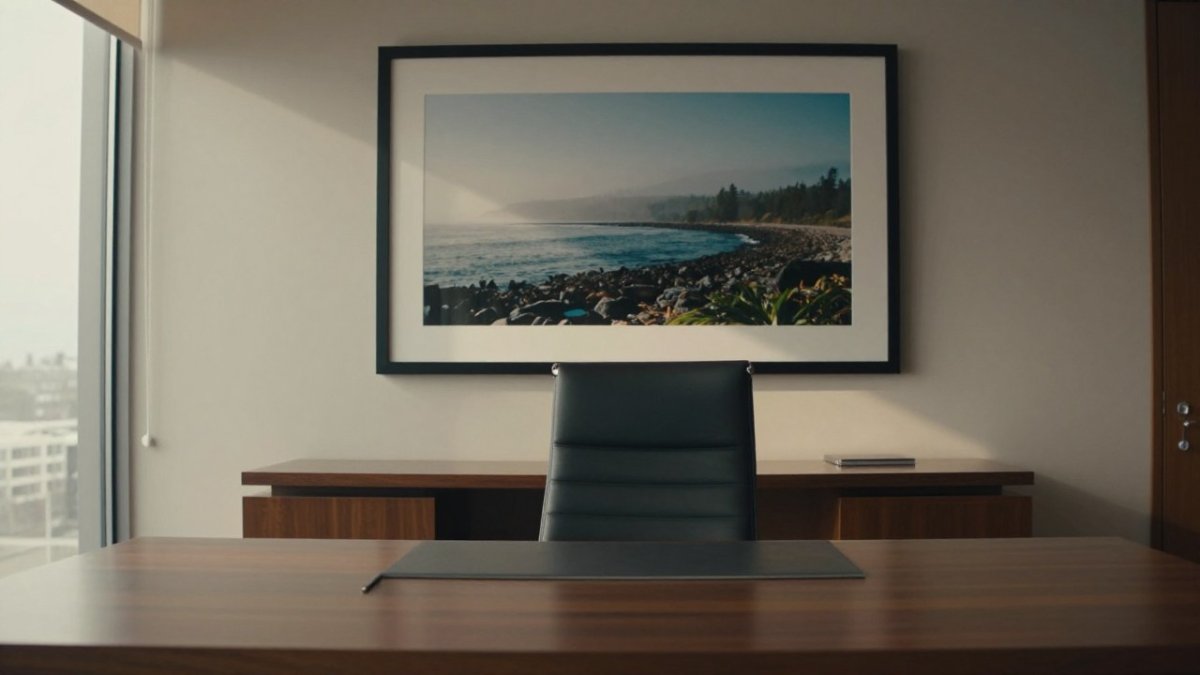
When you buy fine art photography for office walls, size is the first decision. A too-small print on a large wall looks like an afterthought. Measure the wall, then choose a piece that fills roughly two-thirds of the available width above the furniture.
Matching Photography Styles to Your Workplace: From Abstract to Black-and-White
Style should follow function. Energy-driven spaces suit color; formal spaces suit restraint. Use this as your guide.
Color Photography and Abstract Work for Energy and Focus
Color photography lifts rooms that need momentum: sales floors, creative studios, collaborative areas. Abstract photography goes further, offering shapes and color fields that spark conversation without dictating one. A bold abstract piece in a meeting room gives people something to react to, which quietly breaks the ice.
Watch out: highly saturated pieces compete with screens and signage. Keep color work away from walls that already carry brand graphics.
Black-and-White, Portrait, and Architectural Photography for a Polished Look
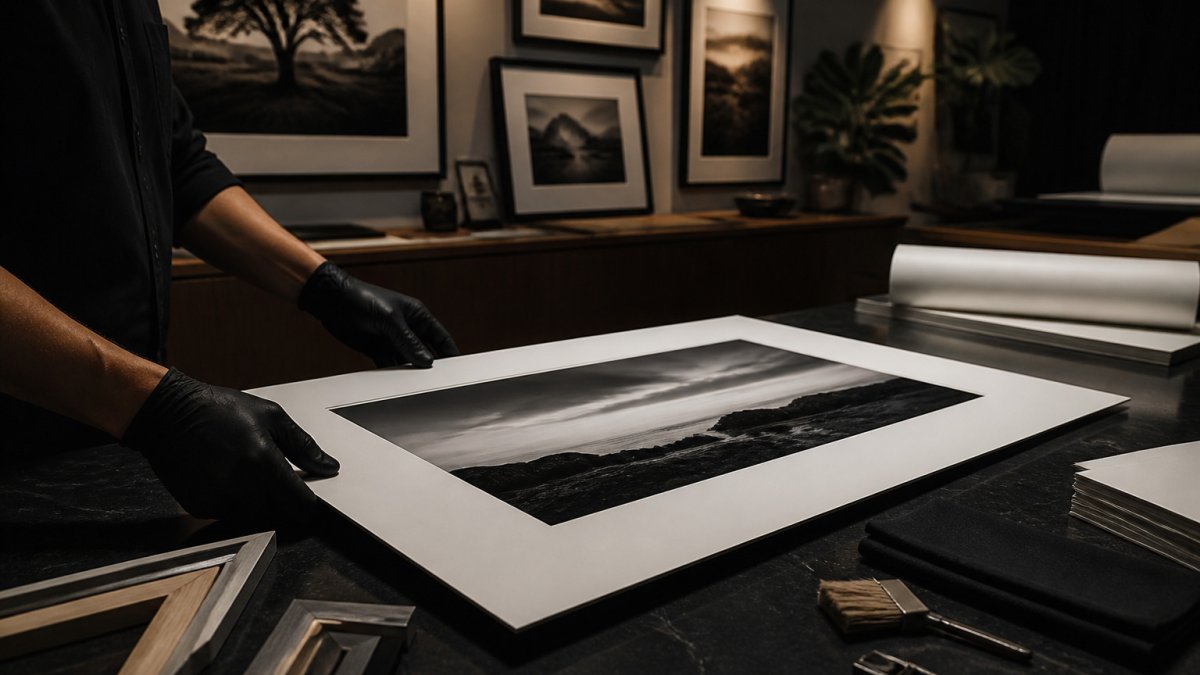
Black-and-white photography reads as timeless and calm, which is why it suits boardrooms, corridors, and executive offices. Architectural photography and cityscape photography bring structure and precision. Portrait photography and figurative photography add a human presence, best placed in reception or client lounges where warmth matters.
A common mistake is mixing too many genres in one sightline. Pick one style per room and let it carry the space.
Print Formats, Framing, and Archival Quality: What Your Money Buys
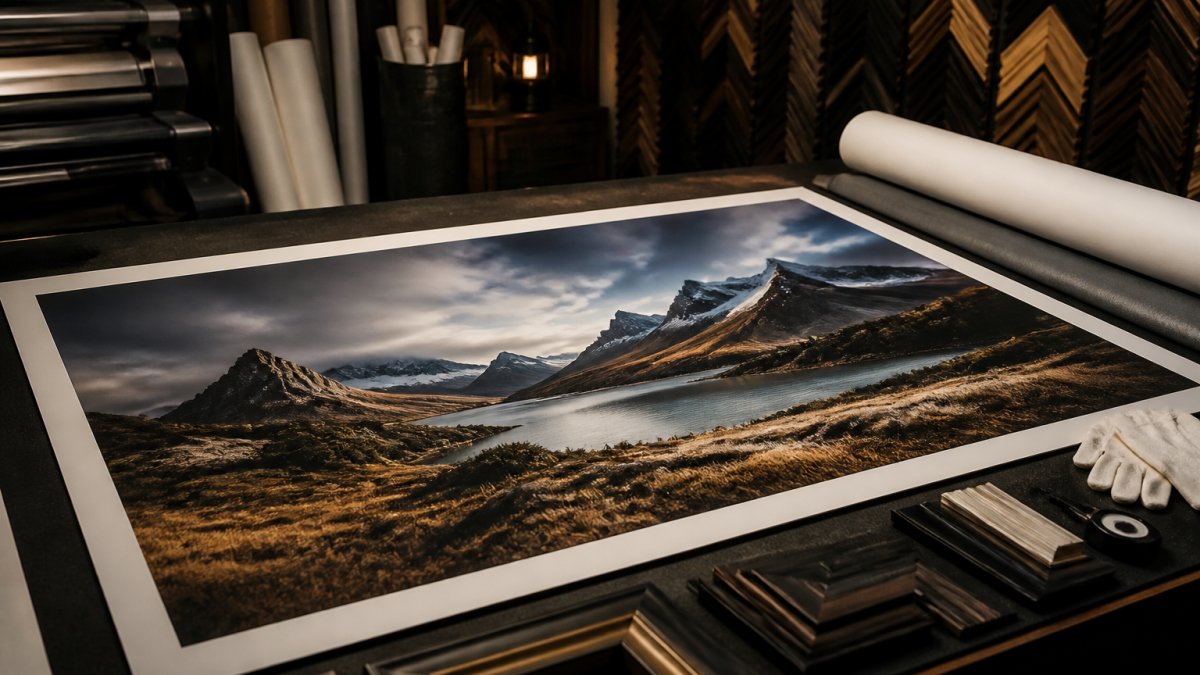
Museum-quality, large-format printing with verified archival materials is the approach DE LA Gallery uses.
Here is what your budget actually covers:
| Element | What to Look For | Why It Matters |
|---|---|---|
| Paper or canvas | Archival, acid-free stock | Resists yellowing and fading |
| Ink | Pigment-based printing | Longer color life than dye inks |
| Framing | Custom framing, sealed backing | Protects against dust and moisture |
| Glazing | UV-filtering acrylic or glass | Blocks the main cause of fading |
| Mounting | Archival mounting, no tape | Prevents ripples and staining |
For a deeper look at whether the spend is justified, read is luxury large scale wall art worth the investment.
Sizing, Placement, Glare, and Long-Term Care for Office Walls
Sizing and placement decide whether a piece looks intentional or accidental. Measure first, then choose.
Start with the wall, not the image. Measure the available width and height above the furniture the artwork will sit behind, a reception console, a credenza, a conference table. As a working rule, a single statement piece should fill roughly two-thirds to three-quarters of that available width. A sofa-height console that is 72 inches wide, for example, pairs well with a framed piece in the 48-to-54-inch range. Anything under about 36 inches wide will read as a postage stamp on a large reception wall.
Center artwork at eye level, roughly 57 to 60 inches from the floor to the middle of the frame. That standard holds for most standing viewers and keeps a piece from floating too high above furniture. If the artwork hangs above a table or console, leave 6 to 10 inches of breathing room between the bottom of the frame and the top of the furniture.
For multi-piece layouts, plan on paper before you drill. A few patterns that work in offices:
- Two-piece diptych: two equal frames hung with 2 to 4 inches between them, treated as one unit and centered on the furniture below.
- Three-piece triptych: three equal frames in a row, same gap, same centerline, strong over a long conference table or reception desk.
- Gallery grid: a 2x2 or 3x2 grid of same-size frames, aligned on consistent gaps, suited to hallways and focus corridors.
- Salon-style cluster: mixed sizes arranged around a central anchor piece, best reserved for a feature wall where the artwork is the point.
Keep the centerline of any grouping aligned with the centerline of the furniture beneath it. Off-center groupings look like mistakes, not choices.
Glare is the office problem nobody plans for. Windows and overhead lights wash out glossy surfaces, so choose matte or UV-filtering glazing in bright rooms and angle frames away from direct sun. A conference room with a wall of windows may need the artwork on an interior wall, or glazing with an anti-reflective coating, to stay readable during daytime meetings.
Watch out: hanging hardware rated for drywall alone will fail under a large framed piece in a high-traffic area, confirm you are anchoring into studs or using appropriate heavy-duty anchors before installation.
Care is simple: dust with a dry microfiber cloth, and keep frames out of direct sunlight and away from heat vents.
Licensing, Editions, and Budget Planning for Business Buyers
Commercial-use rights matter for offices, and they are the question most business buyers forget to ask until after the invoice is paid. A standard artwork purchase typically covers display in your own space only. Reproduction, advertising use, resale, and in some cases public display beyond the purchased premises need separate written permission. Ask before you buy, and get the terms in writing so your facilities or legal team can review them.
Ask about edition details before you buy, and get them in writing.
Budget planning should cover the total installed cost, not just the print:
- Artwork price
- Framing and glazing
- Shipping and insurance
- Installation hardware and labor
- Optional lighting
Then plan the purchasing logistics, which is where office buyers diverge from home buyers:
- **
- **
- Delivery timelines: custom framing and large-format printing add lead time, so confirm production and shipping windows before committing to an opening date or office move.
- **
- **
For buyers watching the entry point, Almost White shows how an accessible piece can sit alongside larger investments in the same collection. Pricing depends on format and edition, so check the DE LA Gallery website for current figures or request a quote.
How to Buy Photography Prints Online Without Getting Burned
Buying photography prints online is safe when you verify four things: the seller, the edition details, the materials, and the return policy. Skip any of them and you are gambling.
A practical checklist:
- Confirm the seller is artist-direct or an authorized gallery
- Ask for edition size and whether the print is signed
- Request the paper, ink, and glazing specifications in writing
- Check the return and replacement policy for shipping damage
- Use a preview tool to judge scale in your actual room
Color shifts between screens and paper are normal, so buy from sellers who describe their printing process and stand behind the result. If authenticity is your concern, our guide on how to verify fine art authenticity before you buy walks through the questions to ask. At DE LA Gallery, we print and frame in-house, offer augmented reality previews so you can see a piece on your own wall, and sell direct from the artist.
Frequently Asked Questions
How much does fine art photography for an office cost?
Pricing depends on print size, format, framing, and whether the piece is a limited edition. A small unframed print sits at the low end, while a large-format, museum-quality framed piece costs considerably more. Because DE LA Gallery prints and frames in-house with verified archival materials, pricing varies by configuration. Request a quote from the gallery with your wall dimensions and room photos so you get an accurate figure rather than a guess.
What size photography print works best in an office?
A common guideline is to fill roughly 60 to 75 percent of the wall width above a piece of furniture, so a 60-inch-wide console calls for artwork around 36 to 45 inches wide. Behind a reception desk or in a conference room, large-format landscape photography prints at 40 by 60 inches or bigger hold the wall without looking sparse. Measure the wall first, then confirm the framed dimensions, not just the image size, before you buy.
Where can I buy photography prints online for commercial use?
Buy from a source that states licensing terms in writing before checkout. Standard print purchases usually cover display in your own space but not reproduction in marketing materials, so ask specifically if you plan to use the image in brochures or ads. Ask DE LA Gallery what rights come with each piece, and get that in writing before you buy.
What should I look for in an archival fine art print?
Look for pigment-based inks, acid-free paper or canvas, and framing with UV-filtering glazing and acid-free matting. Ask whether the printer uses verified archival materials and whether the piece is signed and numbered. These details determine whether a print holds its color for decades or fades within a few years, and a reputable seller will answer without hesitation. Get the specifics in writing before you commit.
Is framed fine art photography suitable for a professional office?
Yes, and it is often the better choice than unframed prints in high-traffic areas. Professional framing protects the print from dust, fingerprints, and light damage while giving it a finished, credible look that reads well to clients. Choose UV-filtering glazing in bright rooms and avoid hanging pieces in direct sunlight. For offices that host meetings, a framed, ready-to-hang piece removes the installation guesswork entirely.
The difference between a wall that fills space and a wall that works for your business comes down to one deliberate purchase. DE LA Gallery represents photographer Jorge de la Torriente exclusively, prints and frames every piece in-house with verified archival materials, and lets you preview artwork in your own space before you commit. Get started with DE LA Gallery and give your office a centerpiece that lasts.