 how-to
Buying Large Scale Photography Online: A Complete Guide
Table of Contents
- Understanding Large Format Fine Art Photography
- How to Choose Art for a Large Wall
- Comparing Archival Photography Prints and Materials
- How to Buy Fine Art Photography Online Safely
- Evaluating Cost, Framing, and Shipping
- What to Do If Your Large Scale Photography Arrives Damaged or Mismatched
- Frequently Asked Questions
Last Updated: October 5, 2026
Understanding Large Format Fine Art Photography
Large format fine art photography is visual storytelling at its peak. When you're buying large scale photography online, you're investing in work that transforms a space, not an enlarged snapshot, but an artistic choice demanding technical precision, archival materials, and an artist's vision.
At DE LA Gallery, we know large scale photography works differently than smaller prints. Scale becomes part of the narrative: a 40x60 landscape isn't just bigger, it's immersive, which shapes how you evaluate resolution and choose materials.
The best large scale photography combines three elements: exceptional image quality, museum-grade printing, and longevity. Without all three, you own an object that fades; with all three, a legacy piece.
How to Choose Art for a Large Wall
Choosing art for a large wall differs fundamentally from selecting smaller pieces: the wall becomes a canvas, and the photograph must engage that space without overwhelming it. Measure your wall accurately, a 12-by-8-foot wall doesn't automatically call for a 48x72 photograph. Consider the room's scale, furniture placement, and typical viewing distance.
Evaluating Dimensions and Aspect Ratio
Aspect ratio, the relationship between width and height, determines how the photograph interacts with your space. Landscape orientation suits horizontal walls; portrait works on vertical walls; square formats anchor a space as focal points.
Most collectors choose dimensions based on wall space rather than composition. When buying large scale photography, prioritize the image's natural proportions over your wall's dimensions.
Assessing Resolution and Print Sharpness
Resolution determines sharpness at viewing distance. A high-resolution original, 50+ megapixels or scanned from large-format film, stays clear at 48 inches or beyond; lower-resolution images show pixelation at large sizes.
Print sharpness also depends on paper and printing technology. Fine art inkjet printing with archival inks preserves detail across the tonal range. Gloss reveals more detail but shows fingerprints; matte reduces glare but can slightly soften fine details.
Comparing Archival Photography Prints and Materials
Archival standards exist for longevity. A print on commercial photo paper might look stunning for two years, then fade by year five. Archival materials, acid-free papers, pigment-based inks, proper mounting, preserve color and contrast for decades. When you're buying large scale photography online, archival certification isn't optional if you want your investment to hold value: it costs only 10-20% more, but the longevity difference is profound.
Paper, Canvas, and Specialty Finishes
Fine art photography prints come in several material options, each with distinct visual and tactile qualities.
Fine art paper remains the gold standard.
Canvas wraps around stretcher bars and hangs unframed for a casual, contemporary look.
Specialty finishes include acrylic face-mounts (luminosity), metal prints (dramatic contrast and durability), and wood mounts (warmth and organic appeal).
For buying large scale photography that will hang for decades, fine art paper with proper framing remains the most reliable choice.
Verifying Archival Standards and Certifications
Legitimate galleries document archival standards. Look for ISO 12233 for print longevity, Photographic Activity Test (PAT) certification for inks, and acid-free paper specifications, measurable standards, not marketing terms.
DE LA Gallery uses verified archival materials in all printing and framing. Jeffrey Rodriguez, our framing expert, selects papers, inks, and mounting materials specifically for permanence, which is why our prints maintain their visual integrity across decades.
How to Buy Fine Art Photography Online Safely
Buying large scale photography online requires confidence in the seller, the artist, and your ability to evaluate the work before it arrives.
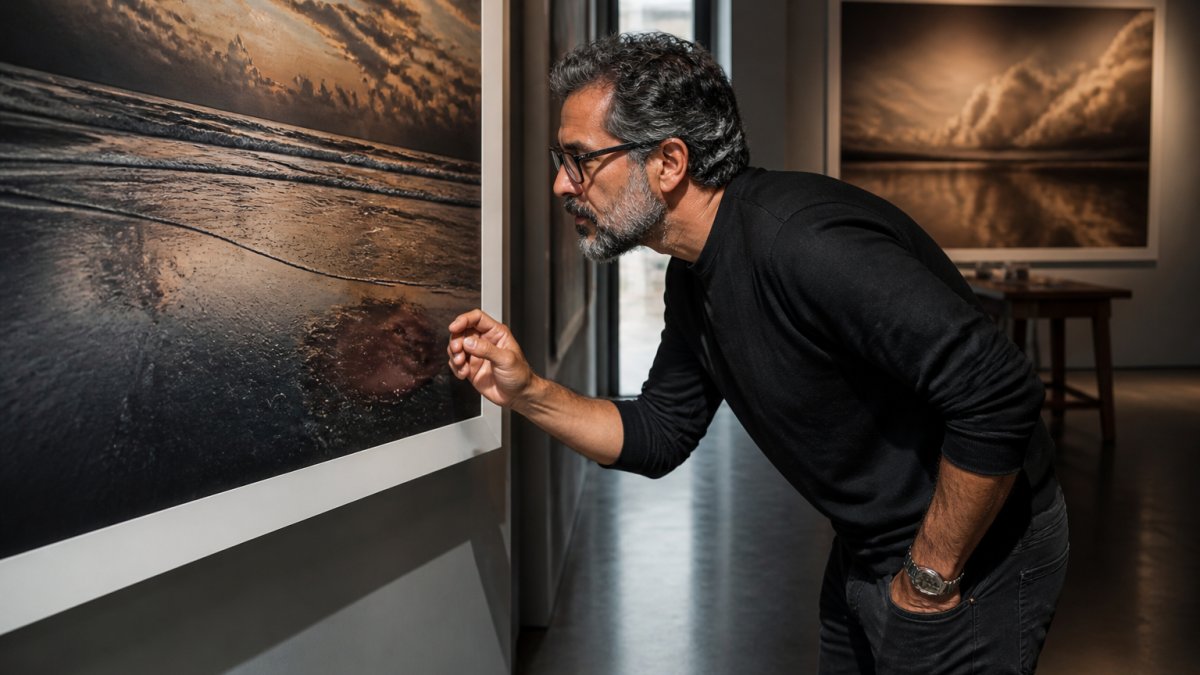
The risk is real: a 48-inch print is a significant investment, and if the colors, paper, or framing disappoint, return logistics get complicated.
Authenticating the Artist and Seller
Verify the artist's credentials and exhibition history. Established photographers have portfolios, gallery representation, and verifiable sales history; multiple gallery relationships mean third-party validation.
DE LA Gallery represents Jorge de la Torriente, a Hasselblad Master photographer whose work has been exhibited internationally. Buying directly from the gallery ensures authenticity and direct access to the artist, you're acquiring work from the source, not through a middleman.
Editions, Signatures, and Certificates of Authenticity
This is where most online listings are weakest. For any limited-edition photograph, ask for four things in writing:
- Edition size and number. "Edition of 25" with your specific number (e.g., 7/25) is meaningful. "Limited edition" with no number is not.
- Signature location and medium. Is the print signed on the front, the back, or on a separate label? Pencil, ink, or embossed chop?
- Certificate of Authenticity (COA). A proper COA names the artist, the title, the edition number, the size, the substrate, the print date, and the printer or studio. It should be signed and, ideally, embossed or numbered to match the print.
- Provenance chain. For resales, ask for the original invoice, prior COA, and any exhibition history. A gap in the chain is a red flag.
Open editions have no limited-edition COA, but a reputable seller still provides a signed invoice describing the print, size, and materials. Keep it, it's your provenance record.
Payment Methods That Protect You
How you pay determines your leverage if something goes wrong.
- Credit card. Under the Fair Credit Billing Act, you can generally dispute charges for goods not received or not as described, the strongest consumer protection for an online art purchase (What To Do if You’re Billed for Things You Never Got, or You Get Unordered Products).
- PayPal Goods & Services. Offers buyer protection for items not received or significantly not as described. Never use "Friends & Family" for art, it removes protection.
- Wire transfer or cryptocurrency. Effectively irreversible. Use only with an independently verified seller, and only after a signed contract specifying the piece, edition number, delivery date, and remedies for damage or non-delivery.
The Pre-Purchase Condition and Specification Checklist
Before you pay, get written answers to these:
- Exact printed dimensions, including any border or bleed
- Substrate brand and finish (e.g., specific cotton rag or baryta paper, matte or glossy canvas)
- Ink type (pigment vs. dye) and stated display permanence
A seller who answers all of these without friction is worth buying from; one who deflects on edition number or glazing type is telling you something.
Using Augmented Reality for Live Previews
Augmented reality lets you visualize how a large scale photograph will appear in your space before purchase. Point your phone at your wall and the AR preview shows the photograph at true size, in your lighting, with your furniture and décor.
DE LA Gallery's augmented reality previews let you test multiple sizes and frame styles in your space, reducing buyer's remorse and ensuring the final piece matches your vision.
Evaluating Cost, Framing, and Shipping
The total cost of buying large scale photography online isn't the sticker price, it's print plus framing plus crating plus freight plus insurance plus installation plus sales tax. Build a line-item estimate before you commit.
What Actually Drives Print Cost
Four variables move the price of a large print more than anything else:
- Surface area. Cost scales with square inches, not linear inches. Doubling the long edge quadruples material and ink: a 40x60 is four times the surface of a 20x30.
- Substrate. Fine art paper is typically least expensive, canvas sits in the middle, and acrylic face-mount and dye-sublimation metal prints top the range. Metal and acrylic usually need custom crating, adding to delivered cost.
- Ink and paper grade. Archival pigment inks on cotton rag or baryta paper cost more than commercial photo paper, but the difference is a modest percentage of the total, not where to economize on a piece you'll keep for decades.
Framing: The Hidden Half of the Budget
For a large print, professional framing is often the largest line item after the print itself. Museum-grade framing, acid-free mat, UV-filtering glazing, archival backing, rigid frame, commonly lands at 30-50% of print cost, and higher for oversized pieces needing custom millwork or acrylic glazing.
Two cost traps to watch for:
- Glass vs. acrylic at large sizes. Glass is heavier and ships poorly above roughly 40 inches; most framers switch to UV-filtering acrylic, which costs more but survives transit.
- Mat vs. float mount. A floated print on a deep frame looks gallery-grade but consumes more material and labor than a matted print.
If a framed price seems too low for the size, ask what glazing and backing they use. The answer usually explains the number.
Shipping Large Prints: What to Expect
Anything over roughly 30x40 inches can't ship in a standard flat box. Expect one of these methods:
- Rigid flat crate for prints up to about 40x60, typically the most economical oversized option.
- Custom wooden crate for acrylic, metal, and framed pieces, which are fragile at the corners and cannot flex.
- White-glove freight for pieces over roughly 60 inches on the long edge, often with inside delivery and unpacking.
Shipping cost is driven by dimensional weight, not actual weight, so a large lightweight canvas can cost as much to ship as a heavy framed print of the same size. Ask for a delivered quote, not an estimate, before you pay, and confirm it includes transit insurance at full replacement value, liftgate or inside delivery, debris removal, and a signature-required delivery window.
Installation and the True All-In Number
A 60-inch framed print can weigh 30-60 pounds with glazing, backing, and frame. Standard drywall anchors aren't adequate. Budget for:
- Two heavy-duty French cleats or a Z-bar hanger rated well above the piece's weight
- Stud-finding and, in many cases, a two-person lift
- A pro installer if the wall is plaster, brick, or has in-wall wiring
A reasonable all-in framework for a large framed print is print + framing + crating + freight + insurance + installation. Get every line in writing; a seller who won't itemize hasn't thought about the last mile.
What to Do If Your Large Scale Photography Arrives Damaged or Mismatched
Despite careful handling, damage occasionally occurs in transit.
First, document everything: photograph the packaging, the damage, and the print itself.
Contact the gallery immediately.
DE LA Gallery guarantees satisfaction. If your large scale photograph doesn't meet expectations, we make it right.
Prevention beats resolution.
DE LA Gallery connects you directly with Jorge de la Torriente's museum-quality fine art photography.
Frequently Asked Questions
What should I look for when buying large-scale photography online?
Focus on image resolution (minimum 300 DPI for print quality), print material (archival-grade paper, canvas, or specialty finishes), dimensions that fit your wall space, and the artist's credentials. Verify archival certifications, check return policies, and use augmented reality previews if available. Confirm the seller is direct-from-artist or a trusted gallery with transparent sourcing, and ask about archival photography prints' longevity guarantees before purchasing.
How can I tell whether a large photographic print is archival?
Archival photography prints use acid-free materials, fade-resistant inks, and lignin-free paper or canvas. Look for certifications from organizations like the American National Standards Institute (ANSI) or independent testing labs. Reputable sellers provide detailed material specifications, expected lifespan (typically 100+ years), and documentation of archival standards. Ask the gallery or artist directly about their printing process, ink formulations, and whether they offer certificates of authenticity with archival guarantees.
How do I choose the right size photograph for a wall?
Measure your wall space and consider the viewing distance. For rooms where you sit 8-12 feet away, choose prints that occupy 50-75% of the wall width. Aspect ratio matters: landscape photographs work well on wide walls, while portrait-oriented images suit narrower spaces. Consider ceiling height and furniture placement. Use augmented reality tools to preview the exact size and placement before buying. Test dimensions by taping paper cutouts to your wall to confirm the scale feels balanced in your space.
Should I buy a large photograph framed or unframed?
Unframed prints offer flexibility to choose custom framing that matches your décor and budget. Framed options provide convenience and professional presentation, especially if the gallery offers expert framing with archival materials. Direct-from-artist galleries often provide in-house framing by skilled professionals using museum-quality materials, ensuring the frame enhances rather than detracts from the photograph. Consider your budget, interior design preferences, and whether you want to customize the frame yourself or prefer a curated, ready-to-hang solution.