 Listicle
Black and White Landscape Photography Prints: What to Buy
Quick Summary
The best black and white landscape photography prints for living spaces are large-format, museum-quality fine art prints on archival materials. Choose the category by use: statement pieces for focal walls, limited editions for collectors, or accessible decorative prints for smaller rooms.
- Size the print to cover roughly two-thirds of the wall width.
- Hang large prints at about 57 to 60 inches to the center for a seated viewer.
- Leave 8 to 12 inches between the frame and the top of a sofa's cushions.
- Matte finishes reduce glare, while glossy finishes add contrast but show reflections.
- Ask sellers for the substrate, ink type, finish, and certificate of authenticity before buying.
Table of Contents
- Why Black and White Landscape Prints Work in Living Spaces
- Best Black and White Landscape Photography Prints for Sale, Ranked by Use
- Choosing a Large Black and White Landscape Photography Print by Room and Wall Size
- Print Materials and Finishes Compared: Canvas, Metal, Acrylic, Fine Art Paper
- Pricing and Value: What Shapes the Cost of a Fine Art Landscape Print
- Vintage and Archival Black and White Landscape Prints: How to Judge Longevity
- Booking Your First Black and White Landscape Print From DE LA Gallery
- Frequently Asked Questions
Why Black and White Landscape Prints Work in Living Spaces
Black and white landscape photography prints strip a scene down to light, shadow, and form. Without color to compete for attention, the eye settles on texture, depth, and mood. That is why these prints suit living rooms, bedrooms, and offices alike. They read as calm, timeless, and sophisticated in almost any decor.
Monochrome also adapts to changing interiors. A black and white mountain scene works with warm wood tones, cool grey walls, and bold accent colors. Collectors often choose it because it does not date the way color trends do.
Watch out: a dark, heavily contrasted print can make a small room feel heavier. Check the print's tonal range against the wall color and the amount of natural light before you commit.
Best Black and White Landscape Photography Prints for Sale, Ranked by Use
Not every print serves the same purpose. We group the options below by how most buyers will use them, so you can start with the category that fits your space.
1. Statement pieces for large walls: Large-format, museum-quality fine art photography suits a living room focal wall or a gallery-style display. Browse a comparable fine art landscape piece, Higgs Beach, to see how gallery pricing is presented.
2. Collector-grade limited editions: Some fine art studios offer signed, numbered editions. These suit buyers who care about provenance and limited availability.
3. Accessible decorative prints: Online marketplaces often carry a broad range of black and white nature prints in several formats. They can fit budget-minded buyers filling a hallway or guest room.
4. Ready-to-hang sets: Multi-piece framed sets give a gallery look with no installation work. They are mass-produced, so expect décor-grade quality rather than archival standards.
Compare options in the table below before you narrow your shortlist.
| Category | Best For | Typical Finish | Archival Focus |
|---|---|---|---|
| Statement large-format | Focal walls, living rooms | Museum-quality paper | High |
| Limited editions | Serious collectors | Acrylic or fine art paper | High, with COA |
| Accessible decorative | Hallways, guest rooms | Canvas, metal, framed | Moderate |
| Ready-to-hang sets | Quick styling, rentals | Pre-framed | Low |
Choosing a Large Black and White Landscape Photography Print by Room and Wall Size
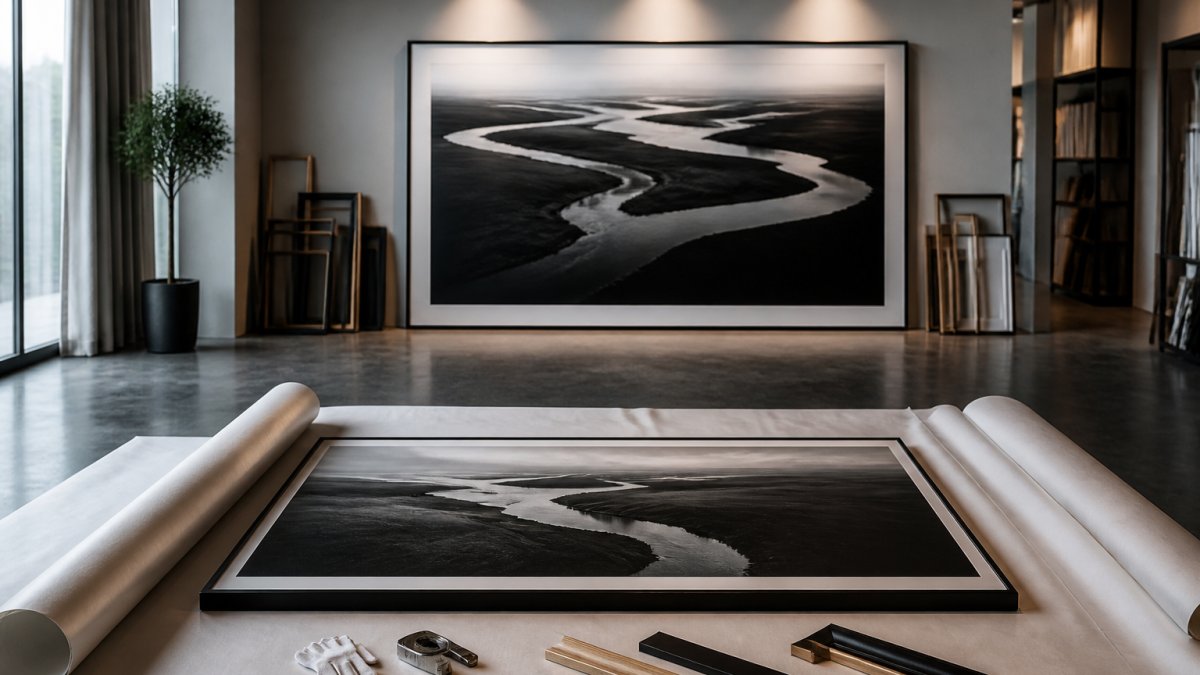
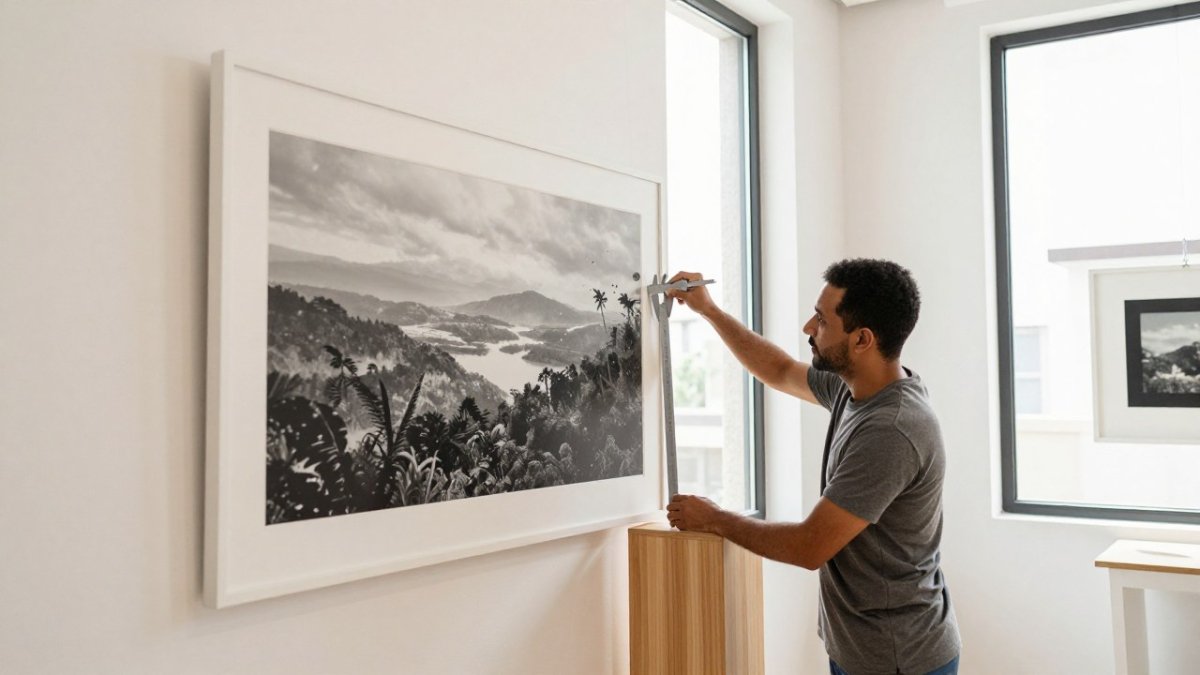
Start with the wall, not the print. Measure the wall width and the furniture below it, then size the print so it covers roughly two-thirds of that width. A print that is too small looks lost, while one that runs edge to edge can feel cramped.
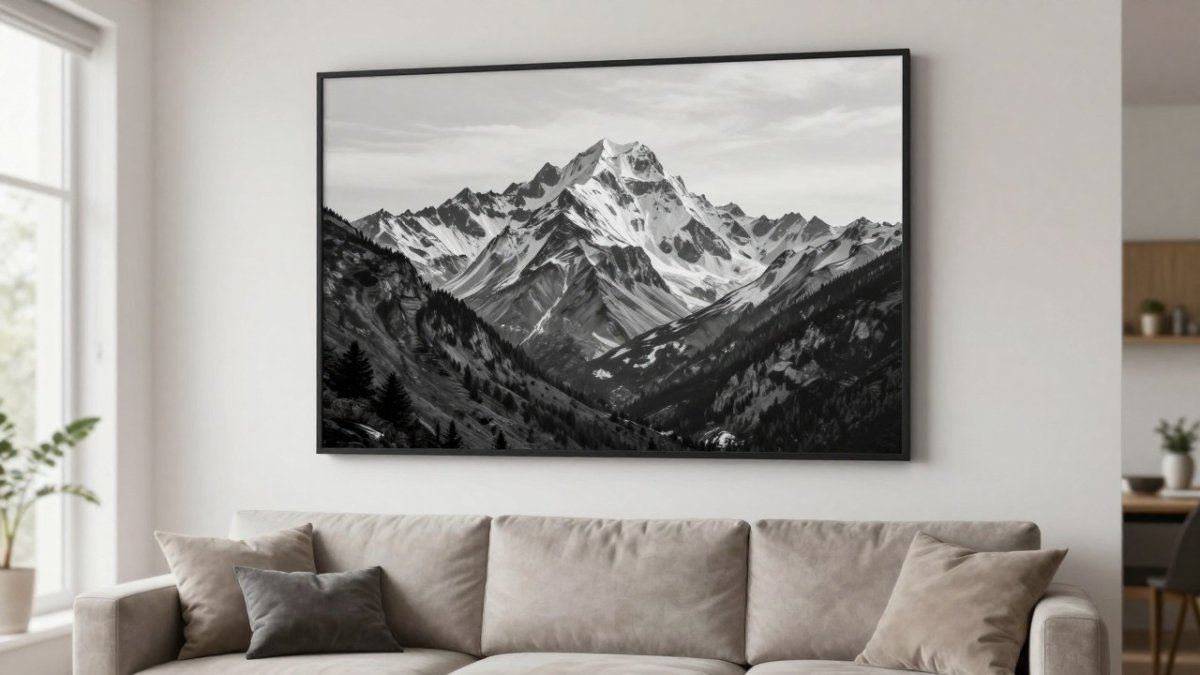
Viewing distance matters too. Large prints look best from several feet away, so hang them at eye level for a seated viewer, about 57 to 60 inches to the center of the image. Over a sofa, leave a gap of about 8 to 12 inches between the frame and the top of the cushions.
A large black and white landscape photography print hanging above a sofa in a bright living room, with natural light and neutral décor, shows how scale and placement work together.
!A large black and white mountain landscape print hanging above a sofa in a bright, modern living room with natural light and neutral decor
Print Materials and Finishes Compared: Canvas, Metal, Acrylic, Fine Art Paper
Material changes how a black and white image looks, how it hangs, and how long it lasts. Use this comparison to match the substrate to your room and your expectations.
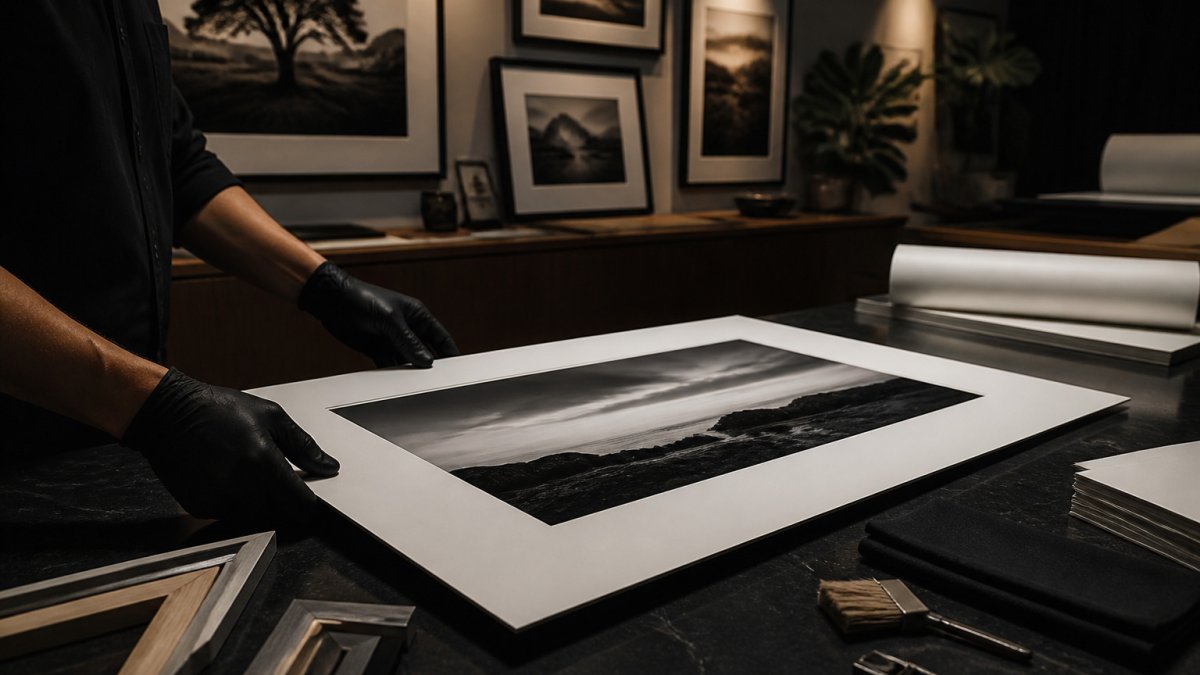
Fine art paper (framed behind glass or acrylic)
- Look: the softest tonal gradation and the most faithful reproduction of a photographer's intent; deep blacks and delicate mid-tones hold up best here.
- Best for: living rooms, studies, and collector walls where the print will be viewed up close.
- Trade-offs: requires framing and glazing, which adds cost and weight; glass can reflect windows and lamps.
- Longevity: archival paper with pigment-based inks and UV-filtering glazing are the materials generally associated with long display life.
Canvas (gallery-wrapped or framed)
- Look: a woven texture and a slightly painterly feel; contrast is softer than paper or metal.
- Best for: large rooms, casual spaces, and rentals where a lighter, easier-to-hang piece helps.
- Trade-offs: texture can soften fine detail; edges need a gallery wrap or a floater frame; canvas is more vulnerable to moisture and dust.
- Longevity: good when stretched on solid bars and coated, but canvas is generally the least archival of the common substrates.
Metal (dye-sublimation on aluminum)
- Look: sharp, luminous blacks and a sleek, contemporary sheen; monochrome landscapes gain a crisp, high-contrast character.
- Best for: modern interiors, kitchens, and offices with cooler color palettes.
- Trade-offs: glossy metal shows fingerprints and reflections; the surface can feel cold next to warm wood and textiles.
- Longevity: the print is fused into a coated aluminum panel, so it resists fading and moisture better than paper or canvas when kept out of direct sun.
Acrylic (face-mounted or direct-print)
- Look: depth and a glossy, high-contrast finish that makes blacks look liquid; colors in a monochrome image read as rich greys.
- Best for: statement walls and contemporary spaces where a reflective surface is acceptable.
- Trade-offs: the heaviest and most fragile option to ship; acrylic scratches and shows dust, so placement away from high-traffic areas matters.
- Longevity: face-mounting on archival paper with UV protection gives strong display life, but the acrylic itself needs careful cleaning.
Wood (direct-print on maple or birch)
- Look: the grain shows through the image, giving a warm, rustic character that softens the precision of a monochrome landscape.
- Best for: cabins, dens, and rooms with natural materials.
- Trade-offs: grain can interfere with fine detail; wood can warp with humidity changes.
- Longevity: moderate; keep wood prints out of damp rooms and away from direct heat.
Finish matters as much as substrate. Matte surfaces reduce glare and reflections, which helps in rooms with windows. Glossy finishes intensify contrast and detail but show fingerprints and reflections more easily.
Matte finish: pros and cons
- Pros: low glare, subtle tonal range, easy to view in bright rooms
- Cons: slightly less punch in deep blacks
Glossy finish: pros and cons
- Pros: strong contrast, vivid detail
- Cons: reflections, visible smudges, harder to place near windows
Ask any seller for the exact substrate, ink type, and finish before you buy. Specifications vary by print, so request a close-up detail image of the blacks and mid-tones if you are comparing options.
Pricing and Value: What Shapes the Cost of a Fine Art Landscape Print
Most collections show a price next to each print but never explain why one 24-by-36-inch landscape costs a fraction of another. This section gives you a transparent framework so you can compare options on value rather than sticker price alone.
The five cost drivers
- Size. Price scales faster than area because large sheets have higher failure rates and require oversized shipping. A print that is twice the width of another is often more than twice the price.
- Substrate. Fine art paper is usually the least expensive archival option; canvas sits in the middle; face-mounted acrylic and metal are typically the most expensive because of material and labor.
- Edition type. Open-edition prints can be reproduced indefinitely and are priced for decoration. Limited editions are signed, numbered, and capped, so the price reflects scarcity as well as production.
- Framing and finishing. A gallery-wrap canvas needs no frame; a paper print needs glazing, a mat, and a frame, which can add a meaningful share to the total. Custom framing is usually the largest single add-on.
- Documentation. A certificate of authenticity and an artist's signature add administrative cost and collector value, but they do not change the print itself.
A practical way to compare value Divide the total price by the finished area in square feet to get a price-per-square-foot figure, then compare that number across options of the same substrate and edition type.
What to ask before you buy
- Is the edition open or limited, and how many prints are in the run?
- What paper or substrate, ink type, and finish are used?
- Is framing included, and what glazing is used?
- Is a certificate of authenticity provided?
- What is the return policy if the print arrives damaged?
We do not publish set prices here because they change with size and options. Visit the DE LA Gallery site for current pricing on Higgs Beach and Blue N Gold, or request a quote for a custom size. Across the market, you will see a wide spread: a mass-market framed print can cost a small fraction of a limited edition from a specialist studio.
Value rests on three things: the print quality, the documentation, and the expected longevity. Judge a print on those, not on the price tag alone.
Vintage and Archival Black and White Landscape Prints: How to Judge Longevity
Longevity depends on the materials used to make the print. Look for archival paper, pigment-based inks, and UV-resistant coatings or glazing. Ask the seller to state these details in writing.
Documentation also protects value. Vintage prints require more caution. Check condition, fading, and the seller's reputation before buying through a secondary marketplace. Our guide to buying photography that holds its value covers what to look for.
Display choices affect longevity too. Keep prints out of direct sunlight, and avoid hanging them above heat sources or in damp rooms.
Booking Your First Black and White Landscape Print From DE LA Gallery
If you want a large-format piece with in-house printing and framing, DE LA Gallery is a starting point worth considering. Its work is direct from the artist, and it uses verified archival materials.
To begin, browse the collection on the DE LA Gallery website, check the size options for your wall, and request a quote for framing and delivery. Use the augmented reality preview to see how a print looks in your own room before you order.
Our advice: decide on the wall first, then the size, then the finish. That order keeps the choice grounded in your space.
Frequently Asked Questions
Where can I buy black and white landscape photography prints?
Black and white landscape photography prints are sold by fine art galleries, photographers' own websites, online marketplaces and secondary platforms. Galleries and artist-direct sellers usually offer limited editions, signed work and documented archival materials, while marketplaces offer a wider range of prices and formats. Compare what each seller specifies about paper or substrate, print process and framing before you buy. For current prices and availability, check the seller's website or request a quote directly, since pricing depends on size, material, edition and framing choices.
How do I choose the right size landscape print for a wall?
Start with the wall, not the print. A common guide is to let a statement piece fill roughly two-thirds of the width of the furniture or wall space beneath it, and to hang it so the center sits at about eye level, around 57 to 60 inches from the floor. Consider viewing distance too: larger prints suit rooms where you sit or stand several feet back, while smaller prints work better in hallways or close quarters. Measure your wall and mark the outline with painter's tape before ordering.
What should I look for in a fine art photography print?
Look for specifics: the print process, the paper or substrate, the ink or pigment type, the edition size, and whether the artist signed the work. Ask whether the print is archival, meaning made with materials designed to resist fading and yellowing over decades. A certificate of authenticity and a clear return or replacement policy are strong signs of a serious seller. Be cautious of vague claims like 'museum quality' without any documentation behind them.
How can I tell whether a photography print is archival?
Ask the seller to name the paper or substrate, the ink or pigment system, and the framing materials, and check whether they state any archival rating or testing. Acid-free mats, UV-filtering glazing and pigment-based inks are common features of archival framing. Be skeptical of 'archival' claims with no supporting detail. A seller who names specific materials and explains how the print is cared for is usually more trustworthy than one who relies on general wording.