 blog
blog
Best Archival Fine Art Photography Prints: 2026 Guide
Table of Contents
- What Makes a Fine Art Photography Print Truly Archival
- The Best Fine Art Paper for Photography: A Material Comparison
- Print Medium Showdown: Paper vs. Acrylic vs. Metal
- Museum Quality Framing Standards Every Collector Should Know
- How to Preserve Fine Art Photography Prints for Decades
- DIY Printing vs. a Professional Lab: The Real Cost of Archival Quality
- Verifying Archival Claims: Certificates, Provenance, and What to Ask
- Frequently Asked Questions
Last Updated: October 2, 2026
What Makes a Fine Art Photography Print Truly Archival
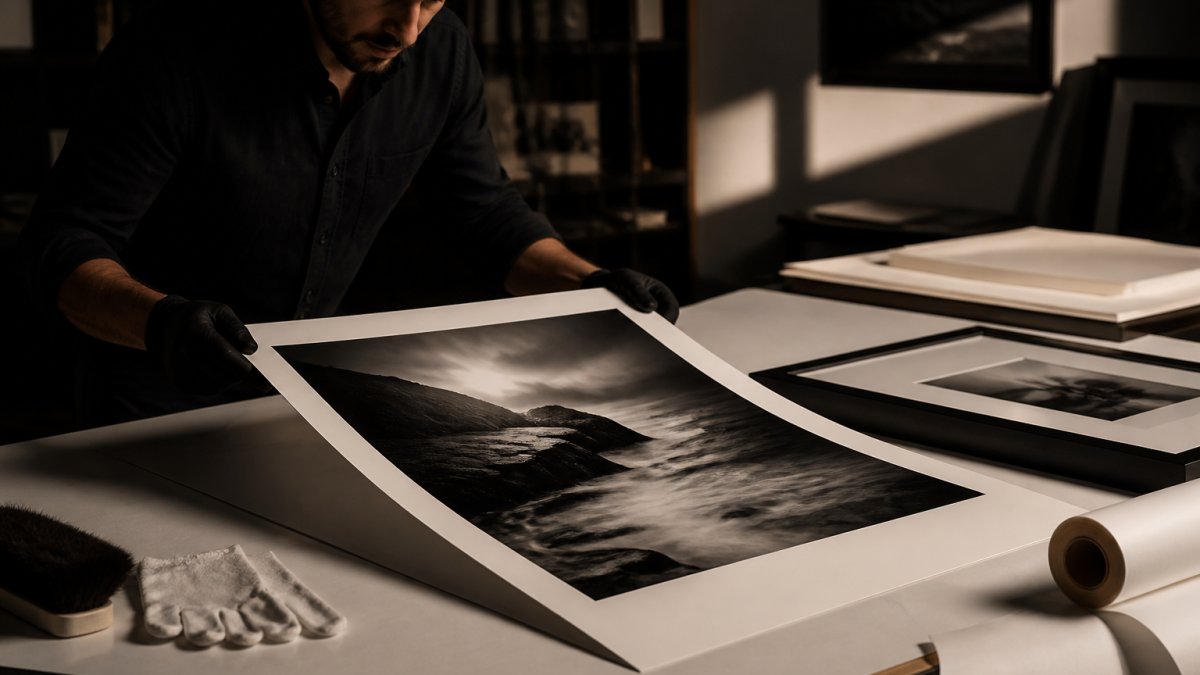
Archival fine art is photography printed and finished to resist fading, yellowing, and physical breakdown for decades, not months. The difference between a print that lasts a lifetime and one that fades in a few years comes down to two things: the ink chemistry and the paper it sits on. At DE LA Gallery, we distinguish ourselves through in-house printing and expert framing by Jeffrey Rodriguez, utilizing verified archival materials. Maintaining this standard of longevity requires careful consideration of mounting techniques and protective enclosures when framing antique photographs to ensure that historical prints remain as stable as modern archival work.
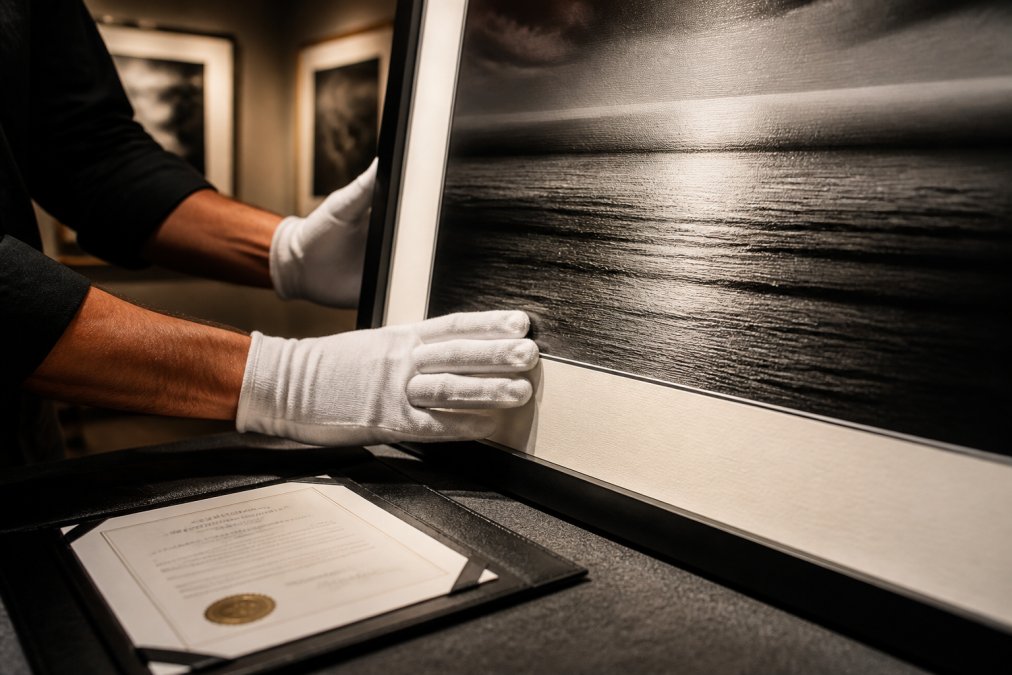
The term archival describes materials and processes tested to resist fading and deterioration over time.
Pigment Inks vs. Dye Inks: The Deciding Factor
Pigment inks use solid color particles suspended in a carrier; dye inks dissolve color into liquid. Pigment particles sit on the paper surface and resist UV breakdown far better than dye, which soaks into the coating and fades faster under light. If a seller cannot tell you which ink system they use, that is your answer.
The Four Pillars of Archival Stability
Four factors decide whether a print survives: ink type, paper composition, UV exposure, and mounting method. Get all four right and a print can outlast its owner. Miss one and the others cannot compensate. A pigment print on acid-free paper still yellows if it is mounted on acidic board.
The Best Fine Art Paper for Photography: A Material Comparison
The best fine art paper for photography is a cotton rag or fiber-based paper with no acid or lignin, because those two substances are what cause paper to yellow and become brittle. But "acid-free" is a floor, not a ceiling. Two acid-free papers can behave very differently under the same pigment ink, and the differences come down to fiber source, coating chemistry, and optical brightening agents.
What Actually Separates One Archival Paper From Another
- Fiber source: Cotton rag (often labeled 100% cotton or alpha-cellulose) and purified wood-pulp fiber (often labeled "fiber-based" or "baryta") are both acceptable. Recycled or mechanical pulp is not, residual lignin breaks down and yellows.
- Coating chemistry: Microporous coatings dry pigment ink fast and hold sharp detail; swellable coatings give deeper blacks but are more moisture-sensitive. Most modern fine art lines are microporous.
- Optical brightening agents (OBAs): These make paper look whiter under daylight but can shift color over decades as the brighteners degrade. Papers marketed as "natural white" or "no OBA" trade a slightly warmer base for more predictable long-term color.
- Surface texture: Smooth (rag), textured (watercolor-style), and baryta (glossy fiber) surfaces each change how much of the paper's tooth shows through the image.
Fiber-Based, Cotton Rag, and Metallic Papers Compared
| Paper Type | Finish | Best For | Archival Notes |
|---|---|---|---|
| Cotton rag | Matte | Landscapes, muted tones | Acid-free, lignin-free, very stable, no OBA in most lines |
| Fiber-based baryta | Glossy | Black-and-white, portraits | Deep blacks, barium-sulfate coating, needs careful handling |
| Metallic | Pearlescent | High-contrast, dramatic scenes | Striking, slightly less neutral, resin-coated base |
| Textured rag | Matte, heavy tooth | Documentary, painterly work | Hides minor surface flaws, less detail resolution |
The Sustainability Angle Most Guides Skip
Archival and eco-friendly are not automatically the same thing. Cotton rag is durable but water-intensive to produce; some mills now offer papers made from bamboo, hemp, or recycled cotton with comparable archival ratings. If sustainability matters to you, look for papers that state both an acid-free/lignin-free claim and a fiber-origin disclosure.
Print Medium Showdown: Paper vs. Acrylic vs. Metal
Paper, acrylic, and metal each solve a different problem. Paper gives you texture and a traditional gallery feel. Acrylic face-mounting sandwiches the print behind optically clear material, boosting color gamut and protecting the surface. Metal prints fuse the image into a coated aluminum panel for a sleek, frameless look.
Museum Quality Framing Standards Every Collector Should Know
Museum quality framing standards require acid-free matting, UV-filtering glazing, and a mounting method that does not glue the print permanently to a board. The goal is reversibility: a conservator should be able to remove the print later without damage.
- Acid-free or cotton rag mat board
- UV-filtering glass or acrylic
- Reversible hinges or corner mounts, not dry-mount adhesive
- A backing board that blocks dust and moisture
How to Preserve Fine Art Photography Prints for Decades
To preserve fine art photography prints, control three things: light, humidity, and handling. UV exposure is the leading cause of fading, so hang prints away from direct sun and use UV-filtering glazing. Keep relative humidity stable and moderate; swings do more harm than a steady level.
- Avoid direct sunlight and halogen spotlights
- Keep humidity steady, away from bathrooms and kitchens
- Dust frames with a dry microfiber cloth, never spray directly on glazing
- Reframe every few decades if mat board shows any discoloration
DIY Printing vs. a Professional Lab: The Real Cost of Archival Quality
Most guides tell you where to buy archival prints. Very few explain what it actually takes to produce one yourself. If you are an artist or a serious collector considering in-house printing, the honest answer is that DIY archival printing only pays off at volume or for experimentation, and the break-even point is further out than most people expect.
What a DIY Archival Setup Actually Requires
- A pigment-ink printer: Dye-based desktop printers cannot produce archival output regardless of paper. You need a printer rated for pigment inks, typically a wide-format model.
- ICC profiles: Generic profiles rarely match a specific paper. Custom profiles (or well-maintained manufacturer profiles for your exact paper) are what keep color accurate.
- A calibrated display: A hardware colorimeter or spectrophotometer plus calibration software. Without it, you are editing blind.
- Controlled lighting: A neutral, consistent viewing light so what you see on screen and on paper actually correspond.
- Consumables: Fine art paper, pigment ink cartridges, and test sheets. Large-format sheets are expensive, and every misfire is a wasted sheet.
The Real Trade-Offs
A professional lab removes the calibration and profiling risk. Color management, proofing, and printer maintenance are handled by people who print daily, and their equipment is maintained to a standard a home setup rarely matches. For a single large statement piece, the lab almost always wins on both cost and consistency.
A Simple Decision Framework
- One print, one image: Use a lab. The setup cost never amortizes.
- A small edition of the same image: Compare lab per-print pricing against your consumable cost per print, then add the value of your time. Labs often still win.
- Ongoing body of work, many images: DIY can make sense once your volume is high enough that consumable savings exceed your equipment and calibration investment.
- You need documented provenance: Labs that issue certificates and keep production records make verification easier than a home setup with no paper trail.
Verifying Archival Claims: Certificates, Provenance, and What to Ask
A certificate of authenticity should name the artist, the title, the edition size, and the materials used. Without it, a print is just a print. Provenance documentation, meaning the record of where a piece came from and how it was made, is what separates a collectible from a decoration.
Ask any seller these questions before buying:
- Which ink system is used, pigment or dye?
- Is the paper acid-free and lignin-free?
- What is the edition size, and is it numbered and signed?
- What glazing and matting are used, and are they archival?
- Does the piece come with a signed certificate of authenticity?
Frequently Asked Questions
What makes a photography print archival?
A print earns the archival label when three things align: pigment-based inks rather than dye-based, acid-free and lignin-free paper or substrate, and UV-protective glazing. Pigment inks resist fading far longer than dye inks, and acid-free materials prevent the yellowing that destroys cheaper prints within a few years. Ask any seller which inks and papers they use before you buy. If they cannot answer specifically, the archival claim is marketing, not a material fact.
Which paper types are best for archival fine art photography?
Cotton rag and fiber-based papers are the standard for archival work. They are acid-free, lignin-free, and hold pigment inks with a wide color gamut. Matte and textured finishes suit landscape and portrait work; glossy and metallic papers deliver deeper contrast but show fingerprints and glare more easily. Paper weight matters too: 200 GSM and above signals a print built to last rather than a poster-grade sheet.
How do I preserve fine art photography prints for generations?
Keep prints out of direct sunlight and away from humid rooms like bathrooms. UV-filtering glazing slows fading, but no glass stops it completely, so rotate pieces away from windows. Use acid-free backing and matting so the paper never touches wood or cardboard. For long-term storage, place prints in acid-free sleeves in a cool, dry space. These steps are what separate a print that survives thirty years from one that fades in five.
What are museum quality framing standards?
Museum quality framing uses acid-free matboard, UV-protective glazing, and a backing that keeps the print off the frame itself. The print should be hinged with archival tape, never dry-mounted permanently, so it can be removed without damage. Spacers keep the glazing off the print surface. These standards protect the artwork and preserve its resale value. A frame that looks expensive but uses acidic matboard will slowly damage the print inside it.
Buying a print is easy. Buying one that still looks right in twenty years takes knowing what to ask. DE LA Gallery handles that for you with in-house printing, expert framing by Jeffrey Rodriguez, and verified archival materials, plus augmented reality previews so you can see a large-format piece in your own space before it ships. Explore the collection and start your piece with confidence.