 blog
Best Andrew Prokos Alternatives for Fine Art Photography
Table of Contents
- Why Collectors Seek Andrew Prokos Alternatives
- How to Choose Fine Art Photography That Fits Your Space
- Comparison Criteria: Evaluating Andrew Prokos Alternatives Side by Side
- Fine Art Photography Print Sizes and Framing Styles
- Archival Fine Art Photography: What to Verify Before You Buy
- Contemporary Landscape Photographers Worth Considering
- Where to Buy and How to Verify Print Authenticity
- Frequently Asked Questions
Last Updated: October 18, 2026
Why Collectors Seek Andrew Prokos Alternatives
Searching for the best Andrew Prokos alternatives usually starts with a specific wall, light, and budget. Prokos is known for high-contrast architectural studies and cityscapes, and collectors who love that look often want more of it, or a nearby variation, from artists they can buy with confidence.
What most buying guides skip: the alternative you choose matters less than how the print was made. A striking skyline on unstable paper behind ordinary glass will look tired long before a quieter image made with archival materials.
Below, we break down how to choose fine art photography for your space, the criteria that separate serious printmakers from resellers, and where each buyer should look first.
How to Choose Fine Art Photography That Fits Your Space
Start with the room, not the artist. The most common mistake is falling for an image online and discovering it overwhelms the wall.
Fine art photography is original or limited-edition photographic artwork printed to a collector standard, signed by the artist, and made with materials intended to last decades rather than years. That definition is the filter.
A practical sequence for choosing:
- Measure the wall and note ceiling height, then pick a print that fills roughly two-thirds of the intended span
- Match the image's mood to the room's function: high-contrast black and white for a study, softer color for a bedroom
- Check the light. Direct sun fades any print over time, so plan for UV-filtering glass or a shaded wall
- Confirm edition size and signature before you fall in love with the image
- Ask how the piece ships and what happens if it arrives damaged
For buyers who want a single artist's cohesive vision rather than a mix, an artist-direct gallery is simpler.
Comparison Criteria: Evaluating Andrew Prokos Alternatives Side by Side
The criteria that matter most are print process, edition documentation, framing quality, price transparency, and seller accountability when something goes wrong.
| Criterion | What to Check | Why It Matters | Typical Range You Will See |
|---|---|---|---|
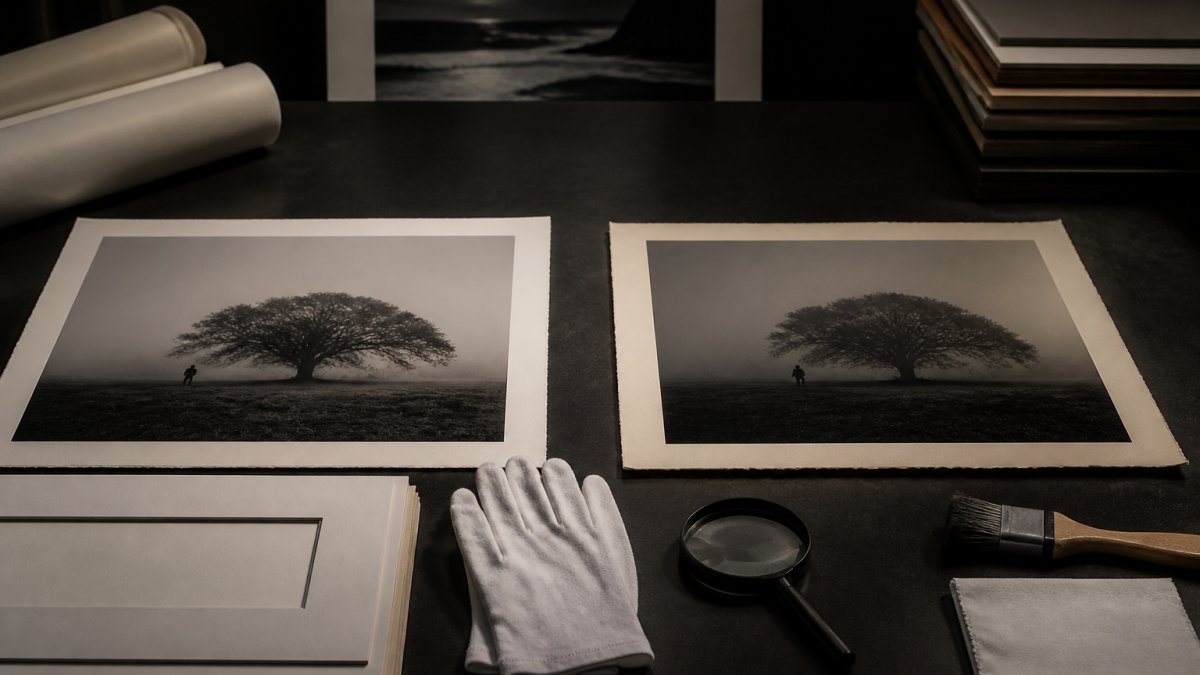
| Print process | Pigment or silver gelatin, printer named, paper stock disclosed | Determines fade resistance and sharpness | Pigment on cotton rag is the collector standard; dye prints are decor-grade |
| Edition records | Numbered, signed, documented, edition size stated in writing | Establishes collectible value and resale potential | Open editions cost less but do not appreciate; limited editions of 25-150 are common |
| Framing | Conservation mat, UV-filtering glazing, acid-free backing | Protects the print for decades | |
| Price transparency | Published price list, shipping and framing costs shown before checkout | Prevents surprise totals | |
| Seller access | Direct contact with artist or studio, physical address, return policy | Faster resolution if a print arrives damaged | Artist-direct studios usually respond within one business day |
A common mistake is treating price as the tiebreaker. A lower-priced print with no edition record and a cheap frame is the more expensive purchase over ten years.
How to score an alternative in five minutes. Open the listing, then answer these questions in order.
- Is the printer and paper named? (Pigment on acid-free cotton rag is the baseline.)
- Is the edition size stated, and is the print numbered and signed?
- Is the frame described as conservation-grade with UV glazing?
- Is the total price, print, frame, shipping, tax, visible before checkout?
- Is there a named human or studio you can contact, and a written return window?
Style matching. Once the five production criteria pass, compare the work itself. If you love Prokos's high-contrast architectural studies and cityscapes, look for alternatives emphasizing geometry, glass, and skyline structure in black and white or restrained color.
Where the alternatives cluster. In practice, Prokos alternatives fall into three buying channels, and each scores differently on the sheet above:
- Artist-direct studios and single-artist galleries, strongest on seller access and edition documentation, because the person who made the print also ships it.
- Multi-artist fine art marketplaces, strongest on selection and price comparison, weaker on direct accountability; verify the edition certificate and return policy carefully.
- Print-on-demand and poster retailers, weakest on edition records and archival framing; treat these as decor, not collectibles.
Run every candidate through the same five questions and channel comparison.
Fine Art Photography Print Sizes and Framing Styles
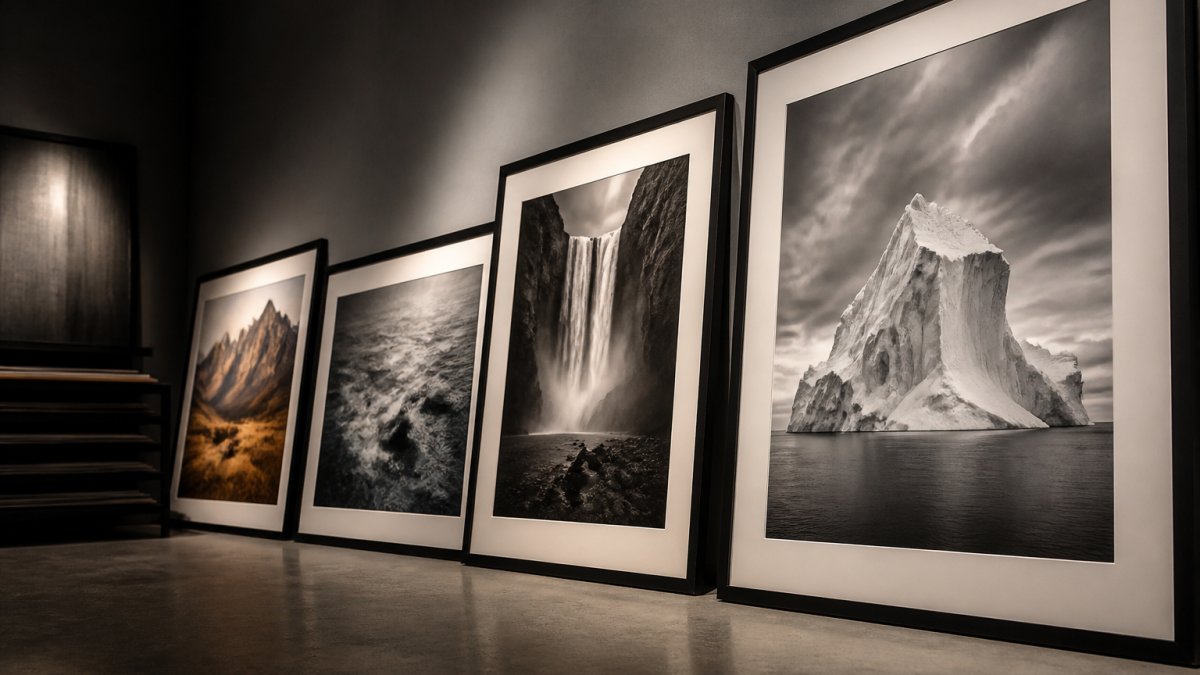
Standard print sizes range from small study pieces to large-scale statement works, and the right choice depends on viewing distance.
Common sizes and where they work:
- Small prints: best for hallways, powder rooms, and paired groupings
- Mid-size prints: the workhorse size for living rooms and offices
- Large-format prints: statement pieces for double-height walls and open-plan spaces
Framing styles change the read of the image as much as the print does.
If you are unsure about scale, ask for a preview. DE LA Gallery supports augmented reality previews so you can see a piece on your actual wall before ordering.
Archival Fine Art Photography: What to Verify Before You Buy
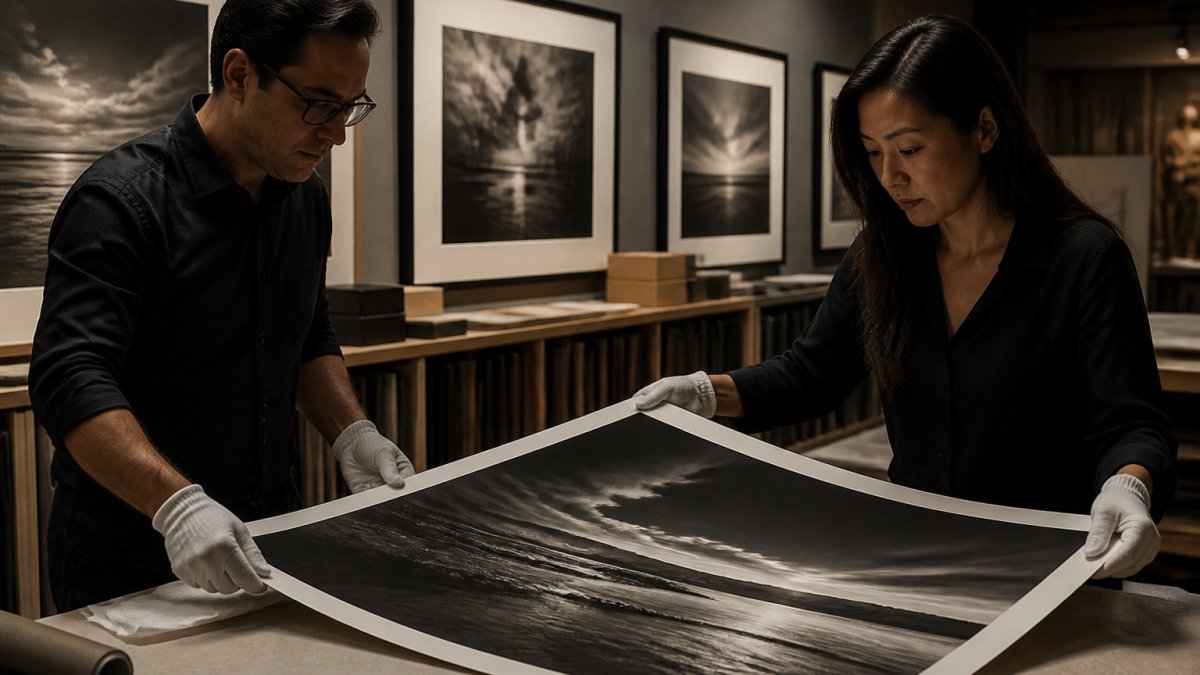
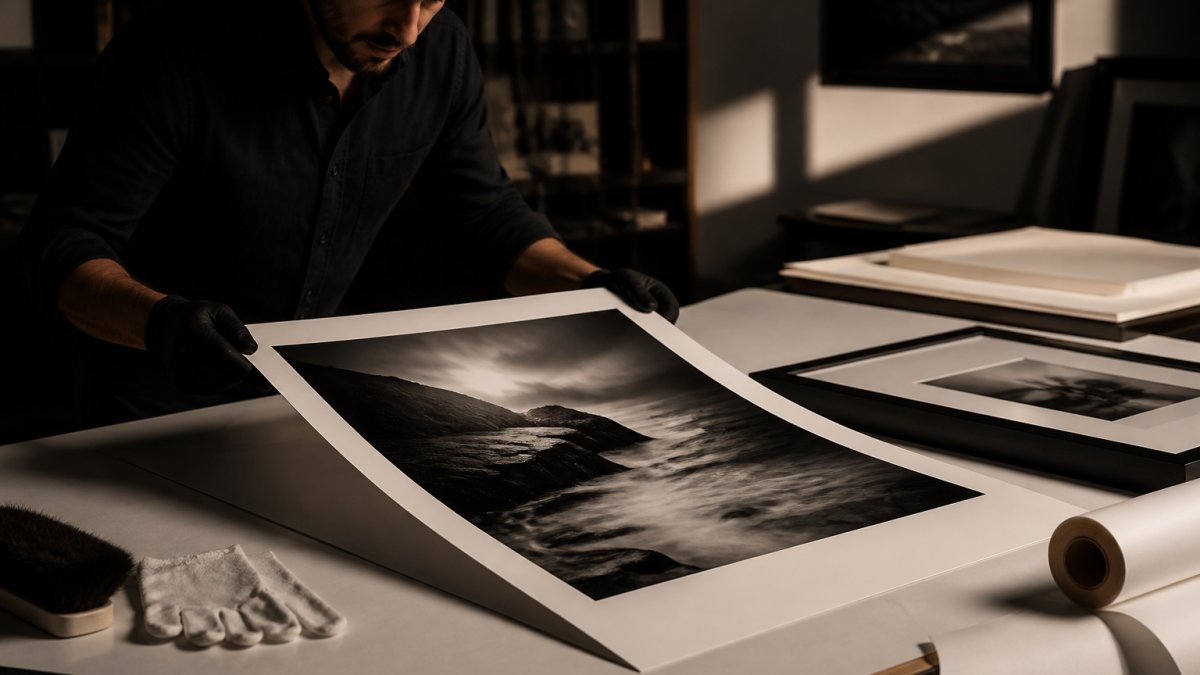
Archival fine art photography means the print was made with pigment-based inks on acid-free paper and framed with materials that will not degrade the image over time. Verification is straightforward if you know what to ask.
What to confirm before purchase:
- The ink type, ideally pigment rather than dye
- Paper or canvas stock described as acid-free or museum-grade
- Mat and backing board labeled conservation or archival
- Glazing that filters UV light
- A signed certificate or edition record stating the print number and total edition size
Sellers who use verified archival materials will state this plainly and in writing. If a listing is vague about paper, ink, or matting, treat that as your answer.
Contemporary Landscape Photographers Worth Considering
Contemporary landscape photographers worth considering fall into a few working styles: architectural abstraction, classical landscape, and urban street work. Knowing which style you respond to narrows the field fast.
- Architectural and cityscape specialists build images around geometry, glass, and skyline structure. Buyers who like Prokos usually start here.
- Classical landscape photographers work with coastlines, forests, and open terrain in a quieter register.
- Street and urban scene photographers capture people and city life rather than buildings alone.
- Abstract and negative-image photographers invert or fragment the scene, producing work closer to contemporary art than documentary.
For collectors who want a single artist's full range, Jorge de la Torriente's series at DE LA Gallery span architectural abstractions, coastal landscapes, and inverted negative-image work, all printed and framed by the studio.
If you prefer to assemble a collection from multiple artists, judge each one on the same criteria above rather than on genre alone.
Where to Buy and How to Verify Print Authenticity
Buy from the artist's own studio or a gallery that represents them directly whenever possible. Artist-direct purchases give you a clear chain of custody, which is what authenticity ultimately means.
The three buying channels, compared.
| Channel | Best For | Typical Price Position | Authenticity Strength | Watch-Outs |
|---|---|---|---|---|
| Artist-direct studio or single-artist gallery | Collectors who want edition records and direct accountability | Mid to high; framing often bundled | Strongest, signed certificate from the studio that printed the work | Smaller selection; you are buying one artist's vision |
| Multi-artist fine art marketplace | Buyers comparing many photographers at once | Wide range, from entry-level to blue-chip | Varies by seller; certificate quality depends on the individual gallery | Confirm who printed the work and who honors returns |
| Print-on-demand and poster retailers | Gifts, rentals, and short-term decor | Lowest | Weakest, usually open editions with no signature | Not collectible; framing rarely archival |
How the total cost adds up. The sticker price is rarely the number you pay. Build a budget from these components:
- Print, the base price, which rises with size and edition status.
- Framing, museum-style framing with a conservation mat and UV-filtering glazing frequently adds $150-$600 per piece, more for oversized works.
- Shipping, large framed pieces usually ship freight or in a custom crate; expect a meaningful surcharge over small unframed prints.
- Tax, sales tax applies in most states where the seller has nexus; marketplaces often collect it at checkout.
- Edition status, a low-numbered print from a small edition can carry a premium over a later number in a larger edition.
Add those five lines before comparing two alternatives.
Verification steps for any purchase.
- Confirm the signature and edition number appear on the print or its accompanying certificate
- Ask for the edition size in writing
- Request the printer, paper, and framing specification
- Check the seller's business registration and physical gallery address
- Read the damage and replacement policy before checkout
Recommendations by buyer and use case. The right channel depends on why you are buying:
- Collectors building a long-term holding should prioritize artist-direct studios and galleries with documented editions, signed certificates, and a named contact. Pay the framing premium; it protects the asset.
- Interior designers furnishing a space should weigh selection and lead time as heavily as edition status. Multi-artist marketplaces and single-artist studios with in-house framing both shorten the timeline; confirm the delivery window in writing.
- Gift buyers should favor smaller unframed or ready-to-hang pieces with a clear return window, since the recipient's wall and taste are unknown.
- Buyers seeking architectural, cityscape, abstract, or landscape work specifically should shortlist studios whose portfolios concentrate in that genre, then apply the five-question scoring sheet.
What buyer experience actually looks like. Independent reviews focus on the same practical factors: how the print was packaged, whether the frame arrived intact, how quickly the studio responded, and whether a return was handled without friction.
For buyers who want that chain intact, DE LA Gallery sells directly from the artist's studio with in-house printing and framing, a secure online checkout, and a physical gallery you can visit. The Federal Trade Commission's guidance on buying art and collectibles is a useful primer on what sellers should disclose. The American Institute for Conservation's guidance on caring for works of art covers storage and display, and the Library of Congress preservation resources explains why light and humidity control matter for any print you hang.
Frequently Asked Questions
What should I compare when choosing a fine art photography print?
Compare the photographer's body of work and exhibition history, the print process (silver gelatin, pigment, or C-print), paper and ink specifications, edition size, and whether the piece ships framed. Ask for the print's archival rating. Also compare total purchase cost including framing and shipping. Request actual print dimensions in both image size and finished framed size before committing.
How can I tell whether a fine art photograph is archival?
Look for specific materials claims: pigment or dye-based inks rated for decades of display, acid-free or cotton rag papers, and UV-filtering glazing on framed pieces. Reputable sellers name the paper and ink lines used. Ask whether the print is signed and numbered, and whether a certificate of authenticity accompanies it. Vague claims like 'gallery quality' without material specifics are a warning sign. When in doubt, request documentation before purchase.
What should I consider before buying a large-format photography print?
Measure your wall first and account for framing and mat borders, since a 40-inch print can finish closer to 50 inches framed. Check ceiling height and viewing distance; large pieces need breathing room. Confirm the print will be shipped in a rigid crate with corner protection, and ask about the damage or replacement policy. For pieces you cannot see in person, use augmented reality previews or a scaled mockup to judge how the image reads in your actual light.
Are there contemporary landscape photographers similar to Andrew Prokos?
Yes. Photographers working in architectural abstraction, black-and-white cityscapes, and large-scale urban scenes offer a comparable visual language. When evaluating alternatives, compare how each artist handles perspective, contrast, and scale rather than just subject matter. Look for artists with museum or gallery exhibition records, limited-edition print runs, and verifiable archival materials. Direct-from-artist galleries let you confirm edition sizes and paper specifications before you buy, which is harder through third-party marketplaces.
The hardest part of buying fine art photography is not finding an image you love. It is trusting that the print will still look right in ten years. DE LA Gallery was built around that problem: we represent Jorge de la Torriente directly, print and frame every piece in house with verified archival materials, and let you preview large-format works on your own wall through augmented reality before you commit. Visit our gallery or shop securely online to start a collection you can keep.